Your logo is the only part of a private-label fitness product that a competitor cannot copy overnight. The weight is the same, the material is the same, the packaging can be knocked off — but the brand mark you put on the product is yours.
The catch is that you cannot use one logo process across your whole range. A mark that works beautifully on a latex resistance band will fail completely on a cast iron dumbbell, and a cast-in logo is meaningless on a soft PVC surface. This guide explains the two decoration methods we actually run — mould and 1C printing — which products take which, and how to get from artwork to an approved sample without burning your 30-day production window.
—
The two methods: what they are, in plain terms
| Logo: mould | Logo: 1C printing | |
|---|---|---|
| What it is | The mark is formed into the product itself — cast or raised/recessed in the metal or baked-finish surface | A single-colour print applied to the surface |
| Substrate it works on | Cast iron and painted / baked finishes | Latex and soft, coated or porous surfaces |
| Where you see it in our spec sheets | UV11101 10 kg black painted cast iron dumbbell set — the spec sheet records “Logo: mould” | UV43101 latex power band, UV61501 PVC + sponge sit-up mat, UV21108 cork + TPE yoga mat — spec sheets record “Logo: 1C printing” |
| Colour capability | Defined by the material and finish | One ink colour |
| Durability | Permanent — it is part of the product | Surface-applied; durability depends on the surface and how the product is used |
| Up-front tooling | Yes — a tool is made for your design | No tooling required |
| Best for | Premium, permanent brand marks on metal | Large-format or repeat branding on soft goods and bands |
| Minimum order | MOQ from 1,000 pcs | MOQ from 1,000 pcs (UV21108 cork + TPE mat: 1,004 pcs; UV61501 sit-up mat: 500 pcs) |
The short version: dumbbells take mould. Yoga mats, resistance bands and sit-up mats take 1C printing.
—
Read the spec sheet: what “Logo: mould” and “Logo: 1C printing” tell you
This trips up a lot of first-time buyers, so it is worth being explicit. On our product pages, the logo line in the specification is not a marketing label — it is the manufacturing route for that item.
- “Logo: mould” means the brand mark is created by a physical tool. The tool exists for your design, at your size, in your position. It is a fixed asset of the production run, and it is why the method is only offered at production MOQ.
- “Logo: 1C printing” means single-colour printing. “1C” is literal: one colour. Not two, not a gradient, not a photograph. If your brand guideline uses a two-tone logo, you need a one-colour lock-up variant before you send artwork.
If a spec sheet does not list a logo line, ask before you assume. The finish determines the route, and finishes vary inside a single family.
—
Product-by-process map
| Product family | Logo route | Note |
|---|---|---|
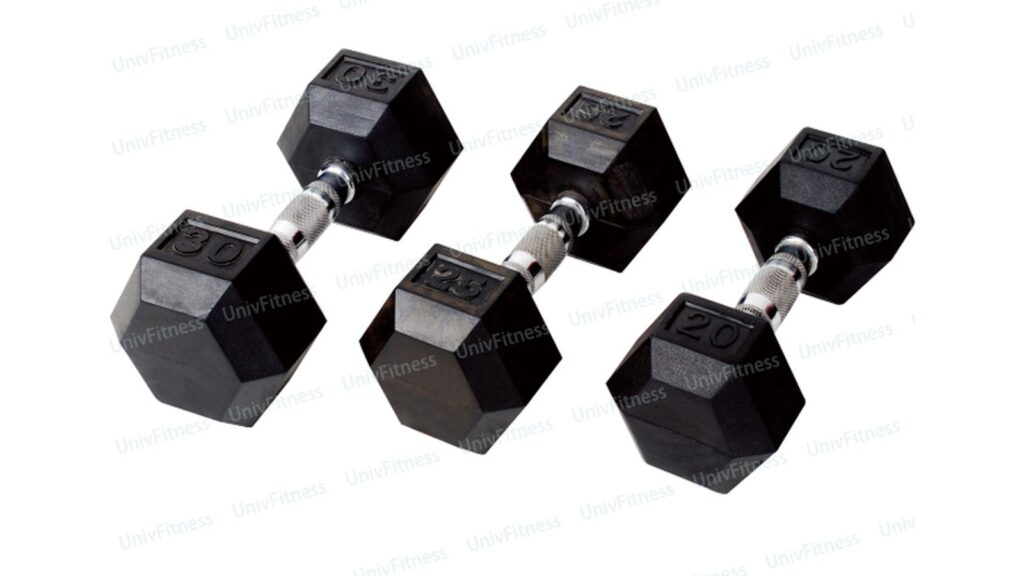
| Cast iron hex dumbbells — UV10601 (2.5–50 kg, MOQ 1,000) | Mould | Cast iron and painted finishes take a moulded mark |
| Black painted cast iron sets — UV11101 (10 kg), UV11104 (15 kg) | Mould | UV11101 spec sheet records “Logo: mould” |
| Chrome set UV11201, grey hammer-tone set UV11001, rubber set UV11302 (star collars), cement set UV11402 | Confirm at sampling | Different finishes behave differently — raise it in your enquiry |
| Rubber hex dumbbells — UV10801 (rubber + chromed steel, 2.5–50 kg, coating in rubber / TPU / PEV) | Confirm at sampling | Coating tier affects the decoration route |
| Vinyl / neoprene / plastic coated light dumbbells — UV10201 (vinyl + cast iron round head, 0.5 / 1 / 2 / 3 / 4 / 5 kg), UV10208 (neoprene + cast iron hex, 1–5 kg), UV10108 (vinyl + cast iron hex, 1–5 kg), UV10302 (PE + sand hex, 1–5 kg) | Confirm at sampling | Soft-coated surfaces are not the same as bare cast iron |
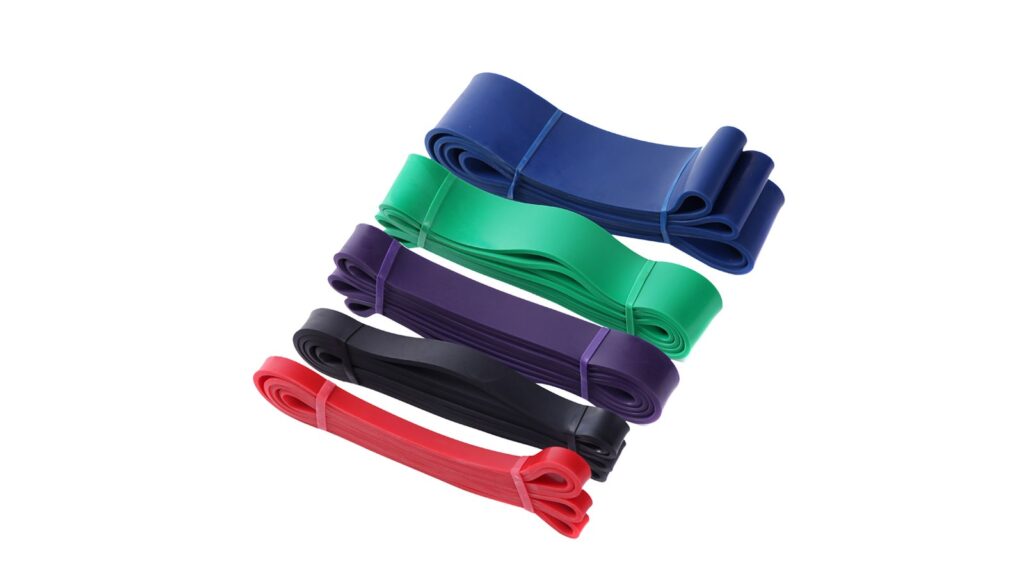
| Latex power band — UV43101 (208 × 0.45 cm, 10 resistance levels, $1.13 indicative FOB wholesale price, MOQ 1,000) | 1C printing | Stated on the spec sheet |
| Sit-up mat — UV61501 (PVC + sponge, 30 × 38 × 7 cm, $3.44 indicative FOB wholesale price, MOQ 500) | 1C printing | Stated on the spec sheet |
| Cork + TPE yoga mat — UV21108 (183 × 61 × 1 cm, 400–1,370 g across eight tiers, $11.48 indicative FOB wholesale price, MOQ 1,004) | 1C printing | Stated on the spec sheet; ships with color poster packaging |
| Other yoga mats — TPE UV21001 (173 × 61 cm, 0.3–1.0 cm in eight tiers), UV21002, UV21003, UV21007, UV21009; NBR UV20901, UV20903; PVC UV20701, UV20703, UV20708, UV20711; EVA UV20801 ($1.48), UV20802 ($4.03), UV20803 ($2.62); cork UV21105 ($18.75), UV21109 ($9.61) | Confirm at sampling | Surface finish (suede, honeycomb, camo, hot-stamped) determines printability |
| Neoprene kettlebell — UV13101 (1–5 kg, neoprene + sand + NBR foam, MOQ 500) | Confirm at sampling | Soft-coated surface |
| Vinyl-dipped kettlebell — UV12301 / UV12302 (cast iron + vinyl, 4–32 kg, MOQ 1,000) | Confirm at sampling | Cast iron core with a vinyl skin |
“Confirm at sampling” is not a dodge. It is the honest answer, because the only reliable way to know how your mark reads on a given finish is to put it on a physical sample — and samples are free, with the sample fee refunded against your bulk order.
—
How the cost structure differs (and why it changes your decision)
We do not publish tooling figures in a blog post, because a tooling cost is specific to a drawing. But the shape of the cost is always the same, and knowing the shape is what lets you negotiate sensibly.
Mould (tooling route)
- There is a one-time tool cost for your design, quoted per drawing, confirmed at the sampling stage.
- The tool cost is amortised across units: the more you make, the smaller it is per piece.
- If you change the design after the tool is cut, you are paying for a new tool. This is the most expensive mistake in private labelling.
- The tool is a physical asset. Ask, in writing, who owns it, where it is held, and what happens at the end of the run.
1C printing (no tooling route)
- No tool is made. Setup is per print position, not per design asset.
- Cost scales with the number of print positions and the coverage area, not with a one-time charge.
- Design changes are cheap before the run starts, and your artwork is reusable across SKUs.
- Because there is no tooling, 1C printing is far more forgiving for a first launch.
Practical consequence: if you are testing a brand, launch with 1C-print products first (power bands UV43101, sit-up mat UV61501, cork + TPE mat UV21108) and move to a mould logo on cast iron dumbbells (UV10601, UV11101) once the design is final and the volume justifies the tool.
—
Artwork requirements: what to send, and what gets rejected
Universal requirements
- Vector file — AI, EPS or SVG. A PNG from your website is not artwork.
- Text converted to outlines — otherwise fonts substitute and your wordmark changes shape.
- One-colour version for any 1C printing application. Flatten tints, drop gradients, drop shadows.
- Placement drawing — show where the mark sits on the product, with dimensions.
- Pantone reference for the ink or finish colour you want.
For 1C printing on resistance bands
The UV43101 power band is 208 × 0.45 cm, and its ten resistance levels are 0.64 / 1.3 / 1.9 / 2.2 / 2.9 / 3.2 / 4.4 / 4.5 / 6.4 / 8.3 cm. Those are band widths, and the narrowest is 0.64 cm. A logo designed for a box cannot sit on a 0.64 cm strip legibly. Design a horizontal lock-up — wordmark or symbol — that survives at the narrowest width in your range, or accept that your smallest band carries a repeated symbol rather than the full lock-up.
Also decide: do you want the mark printed once along the length, or repeated? A repeat pattern reads better in product photography and survives stretching, but it uses more coverage area.
For 1C printing on mats
The UV61501 sit-up mat is 30 × 38 × 7 cm and the UV21108 cork + TPE mat is 183 × 61 × 1 cm. Different canvas, different rules. On the mat, corner placement is standard — it is visible when rolled and when laid flat, and it stays clear of the area a user stands or lies on. On the small sit-up mat, the usable flat area is limited by the 30 × 38 cm footprint, so a compact mark beats a wide wordmark.
For mould on dumbbells
- Place the mark on a flat hex face or the end cap, and keep it clear of the weight marking. A moulded logo that collides with “10 kg” makes both unreadable.
- Respect minimum stroke thickness. Thin serifs and hairlines disappear in cast metal and in paint.
- Keep draft and depth in mind: a recessed mark collects paint and dirt; a raised mark wears on contact surfaces. Decide which you want before the tool is cut.
- Remember the tool is per design. One logo, one tool. Two product lines with different marks means two tools.
—
The approval workflow (this is what protects you)
- Send a brief, not just a file — product SKU, logo route you expect, colour, placement, quantity, target timing.
- NDA first if the design is unreleased. Do not send pre-launch brand assets without a confidentiality agreement in place.
- Confirm the route in writing — mould or 1C printing, on which SKU, at which position. This line in your PO is what the inspection report checks against.
- Request the sample — samples are free, and the sample fee is refunded against your bulk order.
- Approve on the physical sample, photographed at arm’s length and at thumbnail scale. Screen approval is not approval.
- Lock the artwork — after this point, a change to a mould design is a new tool and a new cost; a change to print artwork is a re-plate and a delay.
- Reference the golden sample in the PO — keep your approved unit. It is the arbitration standard if a dispute arises at final inspection.
—
Where the logo sits in the 30-day schedule
Lead time is 30 days from order confirmation, on FOB Shanghai, with 30% advance + 70% before shipment. That 30 days assumes artwork is already locked.
| Stage | Logo-related work | Risk if delayed |
|---|---|---|
| Before Day 0 | Artwork supplied, route confirmed, sample approved | Production cannot be scheduled |
| Days 1–3 | Tool preparation (mould route) or plate/setup (1C route) | Consumes production days |
| Pre-production inspection | Materials and components verified | Your logo position can still be corrected here |
| Production | Decoration applied | Change requests now are expensive or impossible |
| Post-production inspection | Finished goods checked against your approved sample | Late discovery = rework, not a quick fix |
| Before shipment | Inspection report issued, 70% balance paid | Shipment holds until balance clears |
The pattern is simple: every logo decision you push past Day 0 comes out of the 30 days. The cheapest schedule is the one where the sample was approved before you placed the order.
—
Mistakes we see repeatedly
- Designing for mould economics but ordering at 1C volumes. If you are making 1,000 units, do not commit to a tool for a design you may still change.
- Sending a two-colour logo for a 1C process. “1C” means one colour. Supply a one-colour lock-up.
- Ignoring the narrowest band in the range. A mark that works on the 8.3 cm band will be unreadable on the 0.64 cm band.
- Placing the mark where a hand, a floor or a rack touches it. On dumbbells that means the knurl and contact edges; on mats it means the standing surface.
- Approving by photo on a phone screen. Colours shift, and scale lies.
- Changing the logo between the trial order and the reorder. With a mould route that means a second tool. Finalise the mark before the first production run.
—
A simple decision rule
| Your situation | Recommended route |
|---|---|
| First launch, unproven design, testing demand | 1C printing — power band UV43101 ($1.13 indicative FOB wholesale price, MOQ 1,000), sit-up mat UV61501 ($3.44, MOQ 500), cork + TPE mat UV21108 ($11.48, MOQ 1,004) |
| Cast iron or painted dumbbell programme at production volume | Mould — UV10601 cast iron hex (2.5–50 kg) or UV11101 10 kg painted set ($10.94 indicative FOB wholesale price) |
| Premium mat range where the surface is the selling point | 1C printing on cork + TPE (UV21108) or cork (UV21105 $18.75, UV21109 $9.61) |
| You are not sure which applies | Ask before quoting. Send the SKU and your artwork; we will confirm the route in writing. |
—
Get your logo onto a real sample
Send us the SKUs you are considering and a vector of your mark. We will confirm which route each product takes — mould or 1C printing — the placement options, the MOQ, and the indicative FOB wholesale price. Samples are free and the sample fee is refunded against your bulk order, so you can approve your logo on a physical product before committing to a production run.
Everything runs on a 30-day lead time from FOB Shanghai, with inspection before and after production, an inspection report with every order, and payment at 30% advance + 70% before shipment. Custom colours, logos and private-label packaging are all supported.
To get started, send an inquiry to lyle@univfitness.com or use the Enquiry button on each product page.