Ask ten importers what their biggest surprise was on their first container of fitness equipment, and nine of them will tell you the same story: the unit price they negotiated with the supplier was only about 60–70% of what each product actually ended up costing them once it sat in their warehouse.
That gap is your landed cost — the true, all-in cost of getting a product from a factory floor in China to your own door. If you only ever compare the FOB price on a quotation, you are pricing your business blind. Get landed cost right, and you know your real margin on every dumbbell, yoga mat, and resistance band before you ever place an order.
In this guide we break down the landed cost formula, walk through a worked example using real wholesale prices and specs from UnivFitness, and show you where importers most often leak money.
What Is Landed Cost?
Landed cost is the total cost of a product delivered to your destination, including:
- The product cost (the unit price you pay the factory)
- Freight (ocean, air, or courier) from the factory to your port or warehouse
- Insurance
- Customs duties and taxes (import duty, VAT/GST)
- Customs brokerage and clearance fees
- Port, terminal, and handling charges (THC, D/O, unloading)
- Inland delivery (trucking from port to your warehouse)
- Any financing cost tied to the purchase
The formula in its simplest form:
Landed cost per unit = (Product cost + Freight + Insurance + Duty + Taxes + Brokerage + Handling + Inland delivery) ÷ number of units
Everything below that line is what you must know before you can decide whether a quote is actually profitable.
The Landed Cost Formula, Step by Step
1. Product Cost (FOB)
When you buy from a Chinese factory, the most common pricing term is FOB (Free On Board) followed by a port — for UnivFitness, that is FOB Shanghai. The FOB price covers the product plus export packaging and loading it onto the vessel at the Chinese port. It does not include ocean freight, insurance, or anything on your end.
All UnivFitness quotations are FOB Shanghai. For example, our 10 kg black-painted dumbbell set (model UV11101, cast iron plates of 1.25 kg × 2 + 2.5 kg × 2 on a 350 mm chrome bar) carries an indicative FOB wholesale price of around $10.94 per set, packed 20 sets to a carton (101 × 87 × 98 cm, ~11 kg per carton).
2. Ocean Freight
This is the single biggest variable. The same 40-foot high-cube container can cost anywhere from a few hundred dollars to several thousand dollars to ship, depending on the season, the route, fuel surcharges, and the carrier. Two rules of thumb matter here:
- Heavier, denser products ship more cheaply per unit. Cast-iron dumbbells pack a lot of value into a small, heavy cube, so freight per unit is low.
- Bulky, light products cost more per unit. A yoga mat or a foam roller is mostly air, so you pay freight on volume rather than weight.
This is exactly why the FCL vs LCL decision (full container load vs. less-than-container load) changes your landed cost dramatically. Consolidating enough units to fill a container almost always lowers freight per unit.
3. Insurance
Marine cargo insurance typically runs around 0.3% to 0.5% of the commercial invoice value (product + freight). It is cheap, and it is worth it — a damaged carton of rubber hex dumbbells is a write-off if it arrives uninsured.
4. Customs Duty
Duty is calculated on the CIF value (Cost + Insurance + Freight) at the destination country’s rate for the product’s HS code. Most fitness equipment falls under a code in the 9506 family (gymnastics and athletic equipment). The exact rate depends on your country and on the precise HS code assigned — a rubber-encased hex dumbbell can classify differently from a neoprene one. Confirm the correct HS code and duty rate with your broker before you commit to a product mix; a small classification error can add a percentage point to every unit you import.
Duty rates, tax rates, and HS classifications change and vary by country. Always verify the current figures with your customs broker or the relevant national customs authority.
5. Taxes (VAT / GST)
On top of duty, most countries apply a value-added tax or goods-and-services tax on the landed, duty-paid value. This is recoverable for many registered businesses, but it is still cash you must fund at the time of import, so it belongs in your landed cost calculation.
6. Brokerage, Terminal, and Handling Charges
Customs brokerage fees, the terminal handling charge, documentation fees, and the delivery order fee are fixed-ish costs that spread thin over a full container but can become painful on a small LCL shipment. Budget a few hundred dollars per shipment as a safe planning figure.
7. Inland Delivery
The final leg — trucking from the destination port to your warehouse — depends entirely on your distance from the port. Get a quote for this leg rather than guessing.
A Worked Example: Importing 1,000 Rubber Hex Dumbbells
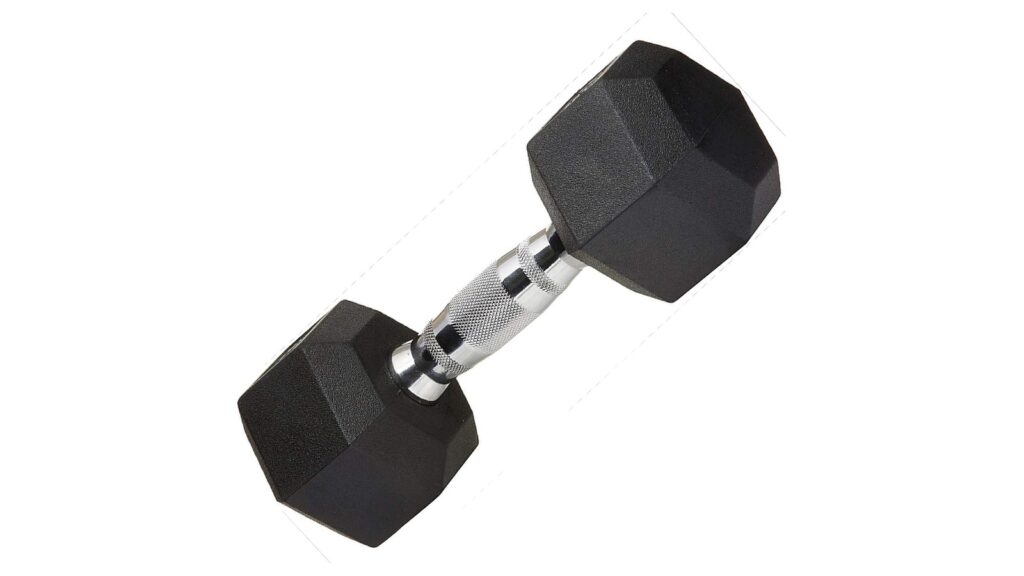
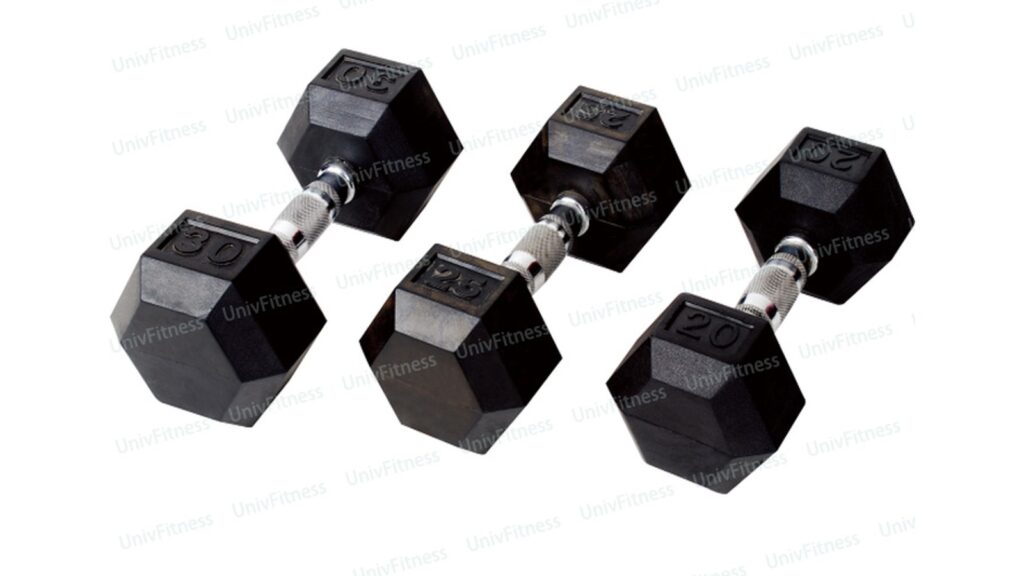
Let’s put the formula to work with a realistic example using UnivFitness product data. We’ll keep the product simple: rubber hex dumbbells (model UV10801), a cast-iron core with rubber/TPU/PEV coating and a chrome-plated steel handle, available from 2.5 kg up to 50 kg, with an MOQ of 1,000 pieces.
Step 1 — Product cost (FOB Shanghai).
Assume a blended order of 1,000 pieces averaging an indicative FOB wholesale price of $2.40 per piece (prices scale heavily with weight; a 2.5 kg piece costs far less than a 20 kg piece — request a full price list for your exact weight mix).
- 1,000 pcs × $2.40 = $2,400.00 product cost.
Step 2 — Freight.
1,000 cast-iron dumbbells are heavy; assume they load into roughly one 20-foot container at a spot rate of $1,800. (This is an illustrative figure — freight rates move constantly; get a current quote from your forwarder.)
- Freight = $1,800.00
Step 3 — Insurance at 0.4% of (product + freight):
- ($2,400 + $1,800) × 0.004 = $16.80
Step 4 — Duty. Assume a destination duty rate of 4% on the CIF value:
- CIF = $2,400 + $1,800 + $16.80 = $4,216.80
- Duty = $4,216.80 × 0.04 = $168.67
Step 5 — VAT/GST. Assume 20% on duty-paid value:
- ($4,216.80 + $168.67) × 0.20 = $877.09
Step 6 — Brokerage, terminal, and handling. Flat estimate:
- $450.00
Step 7 — Inland delivery from port to warehouse:
- $350.00
Total landed cost:
| Component | Amount |
|---|---|
| Product (FOB Shanghai) | $2,400.00 |
| Ocean freight | $1,800.00 |
| Insurance | $16.80 |
| Duty (4%) | $168.67 |
| VAT/GST (20%) | $877.09 |
| Brokerage & handling | $450.00 |
| Inland delivery | $350.00 |
| Total landed cost | $6,062.56 |
| Landed cost per unit | $6.06 |
The lesson is the punchline we opened with: a $2.40 FOB dumbbell is actually a $6.06 dumbbell in your warehouse — roughly 2.5× the unit price. (Every figure above after the product cost is illustrative and country-specific; plug in your own freight quote, duty rate, and tax rate to get your true number.)
Where Importers Most Often Leak Money
1. Comparing only FOB prices. A supplier with a slightly higher FOB price but a heavier, denser, better-packed product can be cheaper on a landed basis than a “cheap” supplier whose goods waste container space.
2. Forgetting volume-to-value for light goods. Yoga mats and foam rollers are bulky relative to their cost. A TPE yoga mat like our UV21001 (173 × 61 cm, available in eight thicknesses from 0.3 to 1.0 cm) ships mostly on volume, so freight per mat can rival the product cost on small orders. This is why the trade term and container consolidation matter so much.
3. Under-funding duty and tax. Importers frequently forget that duty applies to the CIF value, not the FOB price, and that VAT/GST sits on top of duty. These two lines alone can add 20–30% to your invoice.
4. Ignoring the MOQ’s effect on freight. Our wholesale model is MOQ from 1,000 pcs. Ordering below a container’s worth forces you into LCL or courier freight, which is the fastest way to inflate your per-unit cost. Buying enough to fill a container is almost always the better unit economics.
How UnivFitness Helps You Keep Landed Cost Predictable
- Clear FOB Shanghai pricing. Every quotation is FOB Shanghai with a standard 30-day lead time and 30% deposit + 70% before shipment terms, so your product cost is fixed and comparable.
- Real MOQ from 1,000 pcs. The MOQ is designed to make container consolidation realistic for importers and distributors, not to pad order volume.
- Export-ready packing. Dumbbell sets, for example, ship 20 sets per carton with documented carton dimensions and weights, so you and your forwarder can estimate freight accurately before you order.
- Pre- and post-production inspection. We run inspection before and after production and issue a report with every order. Fewer quality surprises at the destination means fewer hidden rework and return costs.
- Free samples. We offer free samples with the sample cost refunded against your bulk order, so you can verify specs and weight accuracy before committing a full container.
Frequently Asked Questions
What’s the difference between FOB and landed cost?
FOB is only the product price loaded at the Chinese port. Landed cost is FOB plus every freight, insurance, duty, tax, and handling charge required to get the goods into your warehouse. FOB is the starting line; landed cost is the finish line.
How do I calculate landed cost per unit?
Add product cost, freight, insurance, duty, taxes, brokerage, handling, and inland delivery, then divide by the number of units. Our example above shows the full breakdown.
Does UnivFitness offer DDP or CIF?
Our standard quotation is FOB Shanghai. If you need CIF, DDP, or door-to-door terms for a specific destination, tell us in your enquiry and we’ll work with your forwarder to quote the best arrangement.
Where can I get the real price and spec for a product before calculating landed cost?
Request a full price list and product spec sheet. Every product page on our site carries its indicative FOB wholesale price, model number, materials, dimensions, and MOQ, so you have the data you need to run your own landed cost model.
Calculate Your Real Cost Before You Commit
Your margin is decided by your landed cost, not by the FOB number that looks cheapest in a spreadsheet. Before your next order, run every product through the formula above — and start from accurate, export-ready product data.
For current FOB prices, full spec sheets, and sample requests, contact us at lyle@univfitness.com or use the Enquiry button on any product page. Tell us your destination country and the products you’re considering, and we’ll help you build a landed cost estimate you can actually plan around.