Freight is the line item that quietly decides whether your import programme makes money. Fitness equipment is the hardest category to estimate, because it contains both the densest product in consumer goods — cast iron — and some of the lightest, bulkiest products in any warehouse, such as latex bands and foam rollers. One container can be limited by weight; the next by volume; the third by neither, because you mixed it correctly.
This guide shows how to calculate the real cost, using actual export carton data from a working Chinese fitness equipment factory, and explains how the FOB / CIF / DDP choice changes who pays for what. All carton dimensions, weights and prices are real data from UnivFitness, a manufacturer operating Wholesale & OEM Only, MOQ from 1,000 pcs, FOB Shanghai, 30-day lead time and 30% advance / 70% before shipment.
The two constraints that govern every container
Every container is governed by whichever limit you hit first:
- Volume — the loadable cubic metres.
- Payload — the maximum cargo weight permitted on that lane, which varies by carrier, route and road regulations at destination.
Standard planning figures:
| Container | Loadable volume (planning) | Typical limiter for fitness goods |
|---|---|---|
| 20 ft | approx. 28 CBM | Payload, for cast iron and machines |
| 40 ft | approx. 55–58 CBM | Volume, for mats, bands and accessories |
The payload cap is not a fixed global number. It changes with the shipping line, the port pair and inland road limits at destination. Always confirm the payload cap for your specific lane with your forwarder before you finalise quantities — this is the single most common way importers mis-plan a free-weight container.
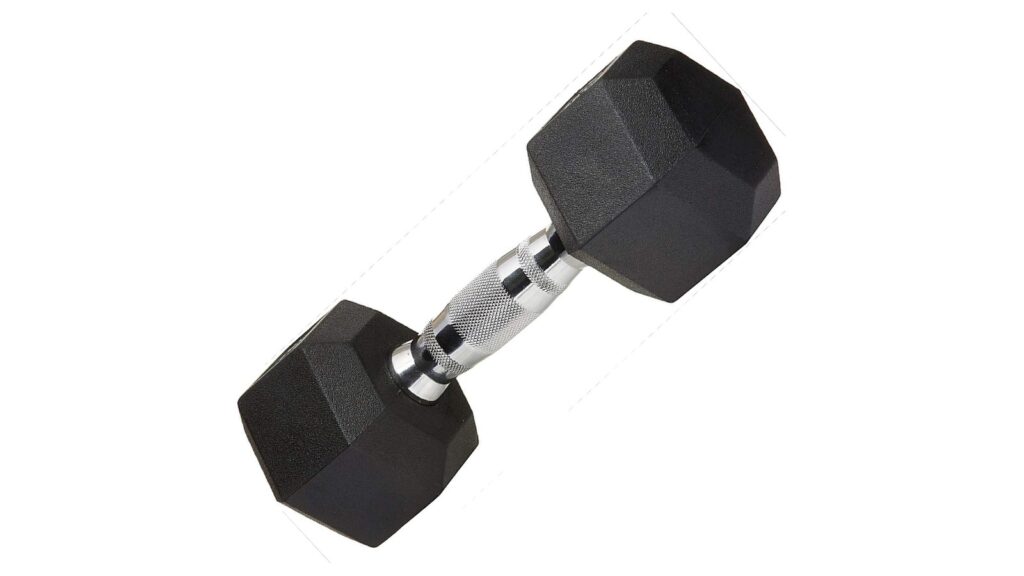
Worked example 1: heavy cargo — UV11101 10 kg painted dumbbell set
Real export data:
- Packing: 20 pcs per carton
- Carton: 101 × 87 × 98 cm
- Set weight: approx. 11 kg
- Indicative FOB wholesale price: $10.94
Volume calculation
1.01 × 0.87 × 0.98 = 0.861 CBM per carton
20 ft container
28 CBM ÷ 0.861 = 32.5 cartons → 32 cartons
32 × 20 pcs = 640 sets
Approximate cargo weight: 640 × 11 kg = 7,040 kg
40 ft container (using 56 CBM as a mid figure)
56 ÷ 0.861 = 65 cartons → 65 cartons
65 × 20 = 1,300 sets
Approximate cargo weight: 1,300 × 11 kg = 14,300 kg
Note what happens here: the 40 ft nearly doubles your pieces, but the weight more than doubles too. At some point on a heavy lane, payload becomes the binding constraint and extra volume is worthless. That is when you either move to a 20 ft with a heavier allowance, split across two containers, or change the mix.
Freight per unit
If a 20 ft on your lane costs F, your freight per set is F ÷ 640. On a 40 ft costing 1.6F, freight per set is 1.6F ÷ 1,300 — meaningfully better per unit. That gap is why serious importers consolidate to 40 ft wherever the payload allows.
Worked example 2: light cargo — UV43101 latex power band
Real export data:
- Packing: 5 pcs per colour card
- Carton: 40 × 28 × 28 cm
- Listed unit weight: 0.06 kg
- 10 resistance levels, widths 0.64 / 1.3 / 1.9 / 2.2 / 2.9 / 3.2 / 4.4 / 4.5 / 6.4 / 8.3 cm
- Length 208 × 0.45 cm
- Indicative FOB wholesale price: $1.13
Volume calculation
0.40 × 0.28 × 0.28 = 0.0314 CBM per carton of 5 pcs
20 ft container
28 ÷ 0.0314 = 891 cartons
891 × 5 = 4,455 bands
Weight: negligible against any payload cap.
Freight per unit
F ÷ 4,455. The freight cost per band is a rounding error. This is why bands, jump ropes, ab rollers and hand grips are the classic “filler” — they convert unused container volume into margin.
The consolidation maths that actually matters
Put the two examples side by side:
| Scenario | CBM used | Approx. weight | FOB value | Freight efficiency |
|---|---|---|---|---|
| 640 × UV11101 only | 27.6 | ~7,040 kg | ~$7,000 | Volume nearly full, weight moderate |
| 4,455 × UV43101 only | 28.0 | minimal | ~$5,034 | Weight allowance wasted |
| Mixed: heavy core + light filler | 28.0 | optimised | higher | Best freight-per-unit blend |
A container of only bands wastes the weight allowance you have already paid for. A container of only cast iron may breach the payload cap before it uses the volume. The optimal container uses both constraints at once — and that is only possible with a supplier whose catalogue spans heavy and light categories.
Real consolidation candidates from the same catalogue:
| Filler category | Products in line | Why it fills well |
|---|---|---|
| Resistance Bands & Tubes | 43 | Very light, very compact |
| Jump Ropes | 77 | Light, small cartons |
| Hand Grips | 35 | Small and dense-packed |
| Ab Rollers | 31 | Compact |
| Push Up Bars | 21 | Compact; check carton per model |
| Yoga Mats | 82 | Bulky — use to fill remaining space deliberately |
| Foam Rollers & Yoga Accessories | 131 | Bulky — plan, do not improvise |
Big-ticket strength equipment: plan carton by carton
Machines do not behave like accessories. Consider the freight profile of these real models:
| Model | Product | Indicative FOB wholesale price |
|---|---|---|
| UV81471 | Vertical knee raise / dip station | $240 |
| UV80874 | 45° linear leg press | $840 |
| UV81241 | 45° curl bench | $518 |
| UV81240 | 45° triceps extension | $518 |
| UV81494B | 3D Smith machine | $1,076 |
| UV81313 | Crossover cable jungle | $2,200 |
| UV81321 | Five-station multi-gym | $2,600 |
| UV81316 | Eight-station | $3,800 |
These ship crated or palletised, with their own dimensions and weight. Never estimate their freight from accessory cartons — request per-model packing data, then decide whether they travel as a dedicated container, as a partial container consolidated with accessories, or as a grouped shipment with other buyers (which your supplier may be able to arrange seasonally).
Note the value density: a few units of UV81316 ($3,800) can represent more FOB value than a full container of accessories. Your insurance, duty and cash exposure look completely different on that shipment, so model it separately.
FOB vs CIF vs DDP: who pays, and who controls
| Term | Factory responsibility | Your responsibility | When to use it |
|---|---|---|---|
| FOB Shanghai | Goods, export clearance, loading onto the vessel at Shanghai | Ocean freight, insurance, destination terminal handling, customs clearance, duty, inland delivery | Default for experienced importers with a forwarder relationship |
| CIF your port | Goods, export clearance and ocean freight plus insurance to your discharge port | Destination terminal handling, customs clearance, duty, inland delivery | When you want the factory to book freight but still control clearance |
| DDP your door | Everything, including clearance, duty and delivery to your address | Unloading | When you have no import capability — usually the most expensive option |
Three practical points:
- FOB is the factory’s standard. UnivFitness quotes FOB Shanghai. That gives you control over freight and visibility of the real cost.
- Never compare an FOB price to a CIF price to a DDP price without converting. Convert everything to landed cost per unit at your warehouse.
- DDP embeds assumptions. A DDP quote includes someone’s estimate of duty, clearance and delivery. If their classification or valuation assumption is wrong, the exposure still lands somewhere — usually on you, later.
What actually makes up landed cost
Budget the full stack, in this order:
- FOB value — the product, e.g. $10.94 for UV11101, $1.13 for UV43101. These are indicative FOB wholesale prices and vary with quantity, material and customisation.
- Origin charges — inland haulage to the port, export documentation, terminal handling at origin (inside FOB).
- Ocean freight — your forwarder’s rate for your lane and container type.
- Marine insurance — under FOB, risk passes at the port, so you carry it.
- Destination terminal handling — charged by the terminal at discharge.
- Customs clearance — broker fee, entry preparation.
- Duty and tax — determined by HS classification, declared value and your market’s rules. Fitness equipment does not fall under a single code: free weights, latex bands, yoga mats, gym machines and textile-filled products classify differently, and rates differ by destination. Confirm classification and rate with a licensed customs broker in your market before you price the order.
- Inland delivery — port to warehouse.
- Contingency — a few percent for inspection holds, demurrage or re-delivery.
Only after all nine can you know your margin. Importers who calculate FOB + freight routinely discover at clearance that they were selling at a loss.
How to reduce shipping cost without changing suppliers
- Consolidate to 40 ft where payload allows. Freight per unit typically improves materially over a 20 ft.
- Mix heavy and light. Use cast iron for value and light accessories to fill volume.
- Ask for carton optimisation. Carton dimensions drive CBM. On light products especially, a small change in packing density changes pieces per container significantly.
- Ship complete, not partial. Splitting a container across two sailings doubles your fixed documentation and clearance costs.
- Plan around peak season. Freight rates and space availability move seasonally; booking late in peak season can cost more than the product margin.
- Lock carton data on the proforma invoice. Carton dimensions, pieces per carton, gross and net weight, and total CBM should be written into the order so the packing list matches reality.
- Use the 30-day lead time properly. Thirty days from deposit and confirmed specification is enough to book freight at a sensible rate if you plan — not if you wait for production to finish.
Pre-shipment checklist
- [ ] Carton dimensions, pieces per carton and CBM confirmed in writing for every model
- [ ] Total CBM and total weight calculated for the whole order
- [ ] Payload cap confirmed with the forwarder for your lane
- [ ] Container type chosen on the binding constraint, not on habit
- [ ] Incoterm confirmed as FOB Shanghai, with CIF or DDP quoted separately if needed
- [ ] HS classification and duty rate confirmed with your broker
- [ ] Marine insurance placed before sailing
- [ ] Inspection report received and approved before releasing the 70% balance
- [ ] Packing list matches the physical container, carton by carton
- [ ] Container and seal numbers recorded at loading
Get the carton data you need to price a container
You cannot price freight on assumptions. You need carton dimensions, pieces per carton, weight and CBM per model — and a supplier who will put them on the proforma invoice.
UnivFitness manufactures across 13 categories and more than 1,500 SKUs, from UV11101 dumbbell sets (20 pcs per carton, 101 × 87 × 98 cm, 0.861 CBM) to UV43101 latex power bands (5 pcs per colour card, 40 × 28 × 28 cm, 0.0314 CBM), plus 772 strength and home gym products and 82 yoga mats. Standard terms: Wholesale & OEM only, MOQ from 1,000 pcs, FOB Shanghai, 30-day lead time, 30% advance / 70% before shipment, free samples with the sample fee refunded on bulk order, inspection before and after production with a report on every order, custom colours, logo and private-label packaging.
Send your model list and quantities — with your discharge port if you also want a CIF comparison — to lyle@univfitness.com, or use the Enquiry button on each product page. You will receive carton data, CBM per model and an indicative FOB quotation you can build a landed-cost model on.