Minimum order quantity is the most misunderstood number in sourcing. Buyers read it as a sales tactic — a number invented to squeeze a bigger order out of them. Sometimes that is true. Usually it is not. A real MOQ is the arithmetic of set-up cost: machine changeover, mould installation, material minimum buy, colour matching, and the packing line’s need for a run long enough to be worth scheduling.
If you understand why the number is what it is, you can work with it instead of against it — and you can often reach an effective minimum far below the headline figure. This guide explains the economics, gives the real MOQs across a full fitness equipment catalogue, and shows the four legitimate ways to order below the stated minimum. All figures are from UnivFitness, a Chinese fitness equipment manufacturer operating Wholesale & OEM Only with MOQ from 1,000 pcs, FOB Shanghai, 30-day lead time, 30% advance / 70% before shipment, free samples with the fee refunded on bulk order, and inspection before and after production with a report on every order.
What MOQ is actually paying for
Before you negotiate, understand the cost components a minimum quantity is designed to cover:
- Machine set-up and changeover. Every coating line, injection machine and latex dipping line has to be cleaned, re-tooled and re-calibrated between runs. That time is fixed whether you order 300 or 3,000 units.
- Material minimum buy. Coating compound, latex, neoprene sheet, TPE and cork are bought in batches. A 300-unit order may still require a full batch of material.
- Colour matching. A custom colour means a matching cycle, and leftover matched compound is waste on a short run.
- Logo tooling or plate set-up. A mould logo (used on cast iron and painted products such as UV11101) is cut into tooling. A 1C printing logo (used on latex and soft-face products such as UV43101 and UV61501) requires a plate and a print set-up. Both have fixed costs that amortise over volume.
- Line scheduling. A production line has finite hours. A run that occupies the line for half a shift must still earn what a full-shift run would earn.
- Packing and documentation. Custom private-label packaging means a print run for the box or card, and print runs have their own minimums.
When you ask a factory to drop below MOQ, you are asking them to absorb fixed costs that do not shrink. The productive way to ask is to remove one of those costs — which is exactly what the tactics later in this guide do.
The real MOQ table by product
MOQ in a manufacturing catalogue is not one number. It varies by process. Here is the actual structure:
| Product family | Models | Material / construction | MOQ |
|---|---|---|---|
| Cast iron hex dumbbells | UV10601 | Cast iron, painted, 2.5–50 kg | 1,000 pcs |
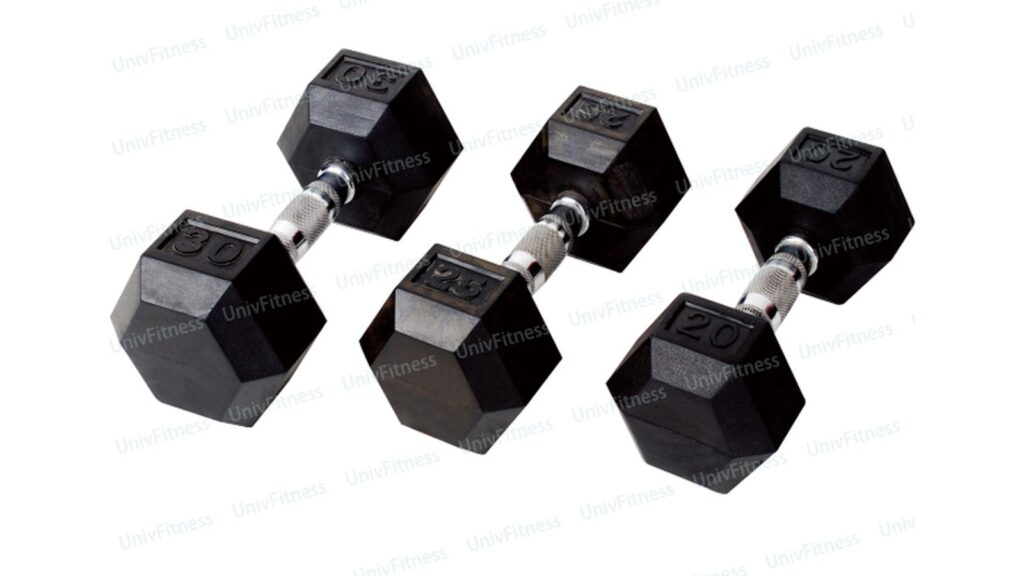
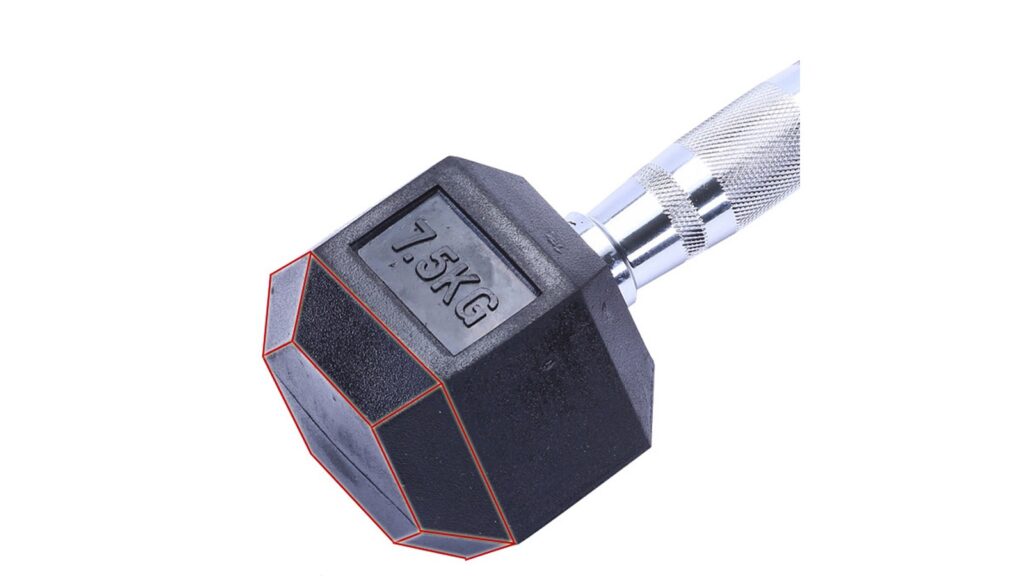
| Rubber hex dumbbells | UV10801 | Rubber / TPU / PEV over cast iron, chromed steel handle, 2.5–50 kg | 1,000 pcs |
| Vinyl round dumbbells | UV10201 | Vinyl + cast iron, 0.5–5 kg | 1,000 pcs |
| Neoprene hex dumbbells | UV10208 | Neoprene + cast iron, 1–5 kg | 1,000 pcs |
| Vinyl hex dumbbells | UV10108 | Vinyl + cast iron, 1–5 kg | 1,000 pcs |
| PE sand-filled dumbbells | UV10302 | PE + sand, 1–5 kg | 1,000 pcs |
| Vinyl-dipped kettlebells | UV12301 / UV12302 | Cast iron + vinyl, 4–32 kg | 1,000 pcs |
| Neoprene kettlebells | UV13101 (1–5 kg), UV13102 (2–6 kg) | Neoprene + sand + NBR foam | 500 pcs |
| Neoprene kettlebells | UV13301 (2–10 kg), UV13302 / UV13303 (2 / 4 / 6 / 8 kg) | Neoprene construction | 500 pcs |
| Kettlebell set | UV13201 | 6 lb × 2 + 3 lb × 2 | 500 pcs |
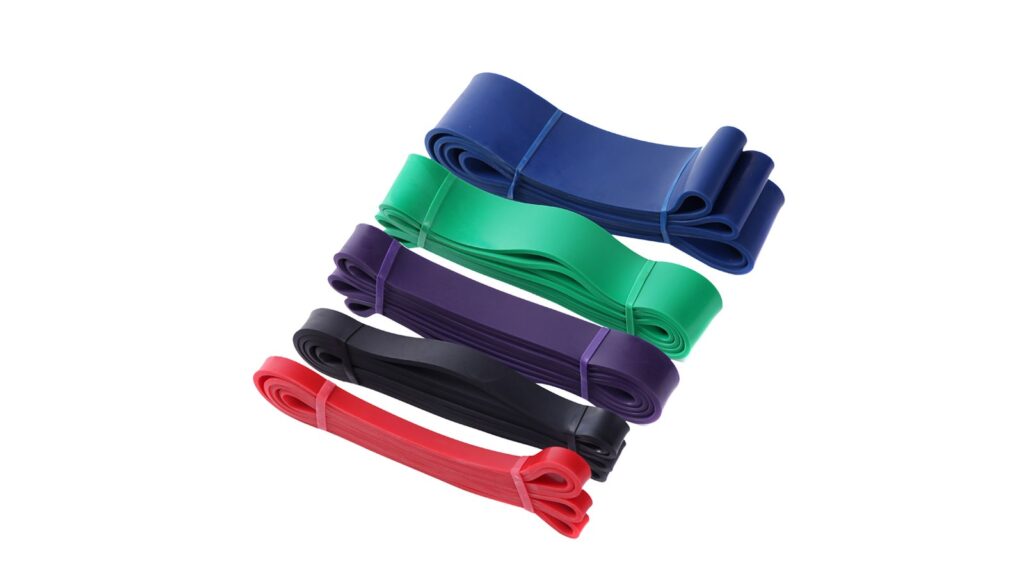
| Latex power band | UV43101 | Latex, 208 × 0.45 cm, 10 resistance levels | 1,000 pcs |
| TPE yoga mats | UV21001 / UV21002 / UV21003 / UV21006 / UV21007 / UV21008 / UV21009 | TPE, various sizes and thicknesses | 1,000 pcs |
| NBR yoga mats | UV20901 / UV20903 / UV20904 / UV20906 | NBR | 1,000 pcs |
| PVC yoga mats | UV20701 / UV20703 / UV20704 / UV20708 / UV20711 / UV20712 / UV20717 / UV20719 | PVC | 1,000 pcs |
| Cork + TPE yoga mat | UV21108 | Cork laminated to TPE, 183 × 61 × 1 cm, 400–1,370 g across eight grades | 1,004 pcs |
| PVC ab mat | UV61501 | PVC + sponge, 30 × 38 × 7 cm | 500 pcs |
| PU ab mat | UV61505 | PU, 34 × 28 × 6 cm, 800 g | 1,000 pcs |
Read three things out of that table.
First, 1,000 pcs is the standard. It applies across dumbbell, band and mat lines because those are the runs where coating, extrusion and dipping set-up dominates.
Second, 500 pcs appears where the process is lighter. Neoprene kettlebells (UV13101, UV13102, UV13301, UV13302, UV13303, UV13201) and the PVC ab mat (UV61501) sit at 500. Neoprene is a cut-and-fill process rather than a casting process, so the fixed set-up is lower.
Third, 1,004 pcs is a real signal of material-driven maths. UV21108 is a cork + TPE mat with eight weight grades from 400 g to 1,370 g. Cork is a natural material bought in specific lots, and the MOQ reflects a full material lot rather than a round marketing number. A invented MOQ is always round. A real one sometimes is not.
Why the headline is “MOQ from 1,000 pcs”
The programme states MOQ from 1,000 pcs as the headline because that is the modal figure across the catalogue. “From” matters: it means 1,000 is the starting point, not a ceiling, and not a floor for every SKU. Some models are 500. One is 1,004. Always confirm the figure for the specific model you are buying, on the proforma invoice.
Four legitimate ways to order below the stated MOQ
1. Consolidate multiple SKUs into one order
Most factories will treat a mixed order as one production programme if the SKUs share a process. A single order of UV13101 (1–5 kg, MOQ 500) plus UV13301 (2–10 kg, MOQ 500) plus UV13201 (MOQ 500) is 1,500 units of neoprene kettlebell production across three models — a single material buy, a single colour-matching cycle, one line booking.
This is the most reliable route to a smaller per-SKU quantity, because it removes the fixed cost rather than asking the factory to absorb it. Ask specifically: “Can I meet the total order MOQ across multiple models within the same material family?”
2. Buy catalogue specification instead of custom specification
Customisation is what drives MOQ. Custom colour, custom logo and private-label packaging each add a set-up. If your first order uses:
- existing colours,
- existing packaging (or factory-standard packing),
- no logo, or logo applied by the lower set-up route,
then the fixed cost drops and the effective minimum often becomes negotiable. Once the product has proven sell-through, add the branding on the reorder at full MOQ.
For reference on logo routes: soft surfaces such as UV43101 and UV61501 use 1C printing, which has no tooling cost. Cast iron and painted surfaces such as UV11101 use a mould logo, which does carry tooling. If you want a low first order, choose a 1C-print product.
3. Split sizes within one model, not across models
MOQ is usually per model, not per size. UV10201 spans 0.5 / 1 / 2 / 3 / 4 / 5 kg. UV10601 spans 2.5–50 kg. UV21001 is offered across eight thickness grades from 0.3 to 1.0 cm. Distributing your 1,000 units across the size range gives you a complete retail assortment from a single minimum — which is usually what you actually wanted anyway.
This is the single most under-used tactic. Buyers ask for 500 pieces of one size and get refused, when 1,000 pieces spread across five sizes was always available and is a better retail proposition.
4. Time your order to the factory’s schedule
Production lines have gaps. If a factory is already running a neoprene colour or a TPE thickness close to yours, an adjacent run is cheaper to schedule. You cannot manufacture this — but you can ask: “What are you running next month that my specification could join?” Ask politely, and be flexible on colour and packaging.
What does not work
Be aware of the approaches that burn credibility:
- “My first order is small but the second will be huge.” Every buyer says this. If it is true, put it in a written forecast with dates — then it carries weight.
- Asking for a lower MOQ without changing anything else. If the set-up cost is unchanged, the factory has no reason to say yes.
- Requesting custom packaging at 300 units. Print minimums are real and are set by the printer, not by the factory.
- Asking for six custom colours on a 500-unit run. Colour count multiplies matching cost. Start with one or two.
How to write an RFQ that gets a yes
Send this, not “please quote best price”:
- Model codes with the exact specification — e.g. UV10801, rubber grade, 2.5–50 kg.
- Quantity per size, not just a total.
- Customisation level, stated explicitly: existing colour / custom colour; no logo / 1C print / mould logo; factory packing / private-label packaging.
- Target date, so the factory can see where you fit in the schedule.
- Consolidation proposal: which other models you are willing to combine.
- Reorder forecast with approximate dates, if you have one.
- Destination port, so you get an accurate FOB Shanghai quote and, if you want one, a CIF comparison.
A factory can work with that. It cannot work with a vague enquiry.
How MOQ interacts with the other terms
MOQ does not sit alone — it is part of a package:
| Term | Standard position | Interaction with MOQ |
|---|---|---|
| Business model | Wholesale & OEM only | No retail or single-unit shipments |
| Headline MOQ | From 1,000 pcs | Per model; 500 on neoprene kettlebells and UV61501; 1,004 on UV21108 |
| Price basis | FOB Shanghai | Lower quantity usually means a higher unit price, because fixed cost is spread over fewer units |
| Lead time | 30 days | Runs from deposit and confirmed specification — artwork delay pushes the clock |
| Payment | 30% advance, 70% before shipment | Unaffected by quantity |
| Samples | Free; sample fee refunded on bulk order | The cheapest way to de-risk a first minimum order |
| QC | Inspection before and after production; report per order | Especially important on a first, minimum-sized run |
| OEM | Custom colours, logo, private-label packaging | Each element adds set-up, and therefore pushes toward the full MOQ |
The price effect matters: a below-MOQ order is not just more expensive per unit — it is more expensive per unit and absorbs more of your cash relative to the inventory you get. Model it before you ask.
A sensible first-order structure
If you have not imported this category before:
- Validate with samples. Free samples, fee refunded on the bulk order. Order across the size range.
- Pick one process family. Neoprene kettlebells (500 pcs) and PVC ab mats (500 pcs) are the lowest-commitment entry points.
- Spread across sizes. UV13101 at 500 pcs across 1 / 2 / 3 / 4 / 5 kg gives you a retail assortment.
- Use existing colours and packaging. Add branding on the reorder.
- Fill the container with lighter, standard-MOQ accessories. Resistance bands at 1,000 pcs (UV43101, indicative FOB wholesale price $1.13) and accessories from the 43-product band line, 77-product jump rope line and 31-product ab roller line make excellent volume fill.
- Make the inspection report your release condition. Hold the 70% balance until you have seen it.
Frequently asked questions
Is the MOQ per model or per order?
Per model, unless a consolidation arrangement is agreed in writing. Ask explicitly and get the answer on the proforma invoice.
Why is UV21108’s MOQ 1,004 and not 1,000?
Because it is driven by a material lot. UV21108 is a cork + TPE mat at 183 × 61 × 1 cm with eight grades from 400 g to 1,370 g, and cork is bought in specific lots. That kind of non-round number is a reliable sign the MOQ is real.
Can I get 500 pcs of dumbbells?
The dumbbell line is listed at 1,000 pcs across UV10601, UV10801, UV10201, UV10208, UV10108 and UV10302. If 500 is your real constraint, consider a 500-pcs family first — neoprene kettlebells or UV61501 — and move to dumbbells on the reorder.
Does a custom logo change the MOQ?
It changes the set-up, not necessarily the minimum. A mould logo on painted cast iron (as on UV11101) carries tooling; a 1C print on latex or soft surfaces (as on UV43101 and UV61501) does not.
Plan your first order around the real minimums
MOQ is not an obstacle — it is information about how your product is made. Read it correctly and you can structure a first order that fits your budget and still gives the factory a run worth scheduling.
UnivFitness operates Wholesale & OEM Only across 13 categories and more than 1,500 SKUs, with real minimums: 1,000 pcs across the dumbbell, yoga mat and resistance band lines; 500 pcs on neoprene kettlebells (UV13101, UV13102, UV13301, UV13302, UV13303, UV13201) and the UV61501 PVC ab mat; 1,004 pcs on the UV21108 cork + TPE mat. Standard terms: FOB Shanghai, 30-day lead time, 30% advance / 70% before shipment, free samples with the fee refunded on bulk order, inspection before and after production with a report on every order, and custom colours, logo and private-label packaging.
Send your model list, per-size quantities, customisation level and consolidation proposal to lyle@univfitness.com, or use the Enquiry button on each product page, and you will get a written confirmation of the minimum that applies to your specific configuration.