Every importer of fitness equipment eventually hits the same wall: your quote is approved, the factory is ready to produce, and then the freight forwarder asks a single question — FCL or LCL?
Get it wrong and you either pay for empty container space you don’t need, or you wait extra weeks while your cartons share a container with someone else’s cargo and get handled several times along the way. For a category like gym equipment — where a single carton of cast-iron dumbbells can weigh 20 kg and a whole order can tip 10 tonnes — the decision is rarely a coin flip.
This guide explains the difference between Full Container Load (FCL) and Less than Container Load (LCL), how to calculate where the cost break-even sits, and how the physical characteristics of dumbbells, kettlebells, and yoga mats push you one way or the other. It is written from the factory side: UnivFitness is a Chinese fitness equipment manufacturer shipping wholesale and OEM orders worldwide on FOB Shanghai terms.
What FCL and LCL actually mean
FCL (Full Container Load) means you book an entire container — typically a 20-foot (20GP), 40-foot (40GP), or 40-foot high-cube (40HQ) — exclusively for your cargo. Whether the container is 60% or 95% full, you pay the flat rate for the box. Your goods are loaded once at the factory, sealed, and only opened at destination.
LCL (Less than Container Load) means your cargo shares a container with other shippers’ goods. You pay per cubic metre (CBM) or per weight tonne, whichever is higher, and a consolidator combines your cartons with other shipments bound for the same port.
The short version: FCL is cheaper per unit of space when you use most of the box; LCL is cheaper in absolute terms when your volume is small. The entire decision reduces to estimating your cargo volume, then finding the break-even point.
Step one: estimate your cargo volume in CBM
Ocean freight is quoted in cubic metres (CBM). To estimate your shipment you multiply each carton’s length × width × height (in metres) by the number of cartons.
Two quick reference points matter more than anything else for fitness equipment:
- Dense, heavy products (dumbbells, kettlebells, weight plates, barbells) are almost always weight-limited. A 20GP container has a typical payload of roughly 21,000–28,000 kg depending on the line and box. Cast iron is about 7.8 g/cm³ — so you can hit the weight ceiling long before the container looks physically full.
- Light, bulky products (yoga mats, foam rollers, resistance bands, jump ropes) are volume-limited. You run out of usable space (typically ~28 CBM in a 20GP, ~58 CBM in a 40GP, ~68 CBM in a 40HQ) before you come close to the weight limit.
These numbers are general industry ranges and vary by carrier, route, and container spec — confirm exact payload and internal dimensions with your forwarder for every booking.
Why fitness equipment is unusual: two opposite cargo profiles in one catalog
This is what makes the FCL/LCL decision tricky for gym equipment importers. UnivFitness carries more than 1,700 products across 13 categories, and they split into two extremes:
Profile A — the “heavy metal” products (weight-limited)
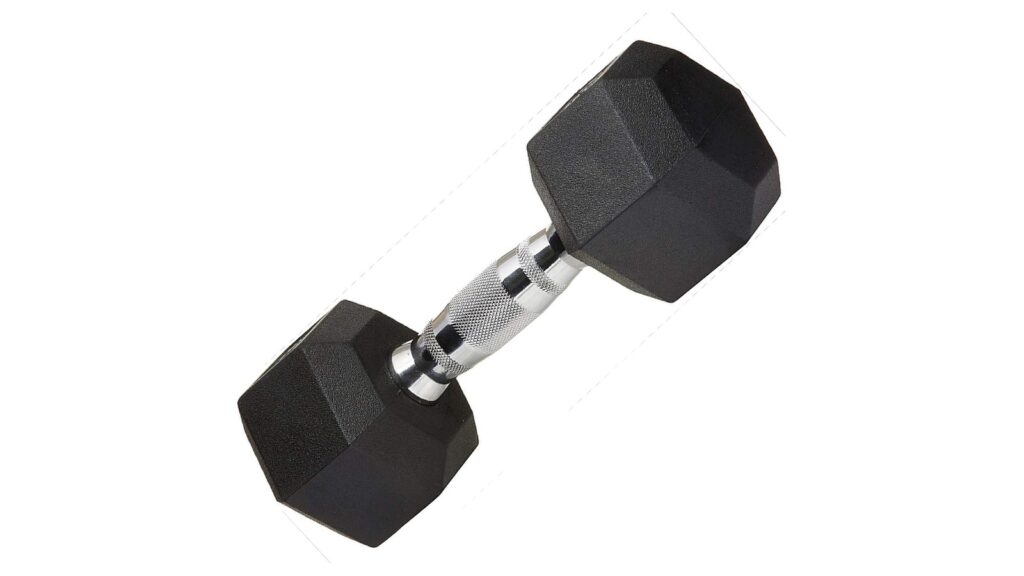
Cast-iron and rubber-encased dumbbells, kettlebells, and barbells are dense. Consider the individual dumbbell range:
| Model | Type | Material | Weight range |
|---|---|---|---|
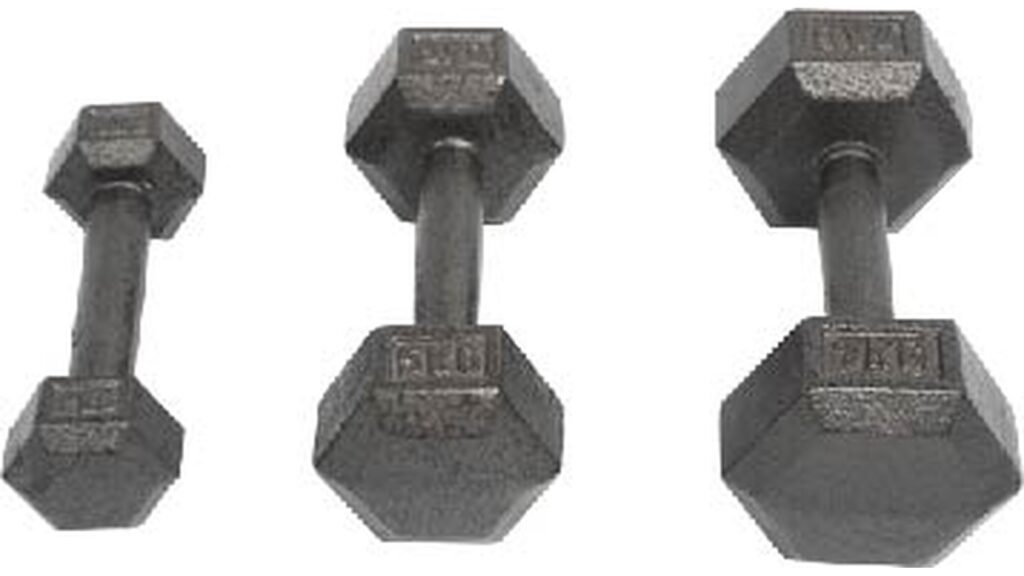
| UV10601 | Hex dumbbell | Cast iron | 2.5–50 kg |
| UV10801 | Hex dumbbell | Rubber / TPU / PEV encased, chrome steel handle | 2.5–50 kg |
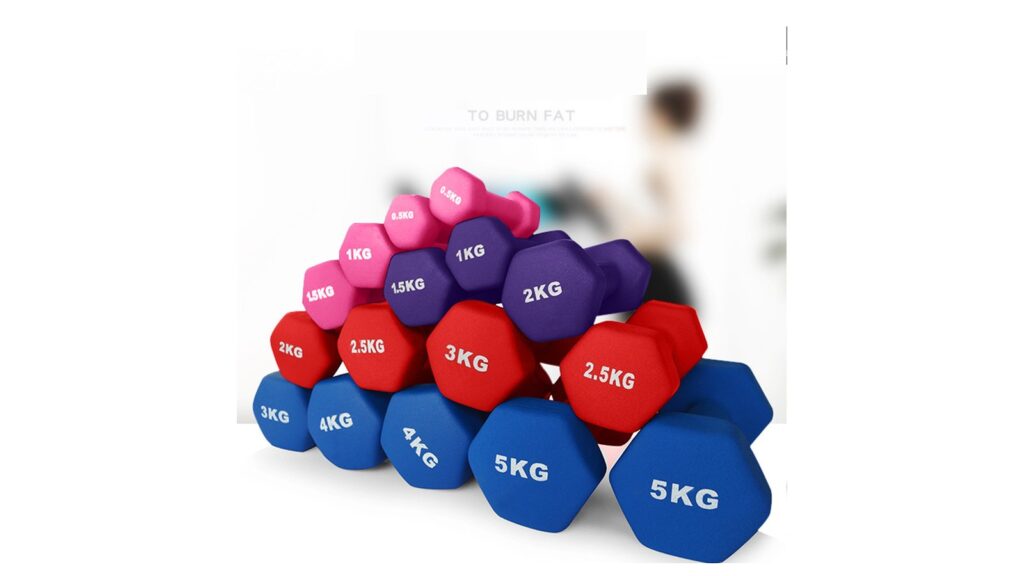
| UV10201 | Round dumbbell | Neoprene + cast iron | 0.5–5 kg |
| UV10108 | Hex dumbbell | Vinyl + cast iron | 1–5 kg |
| UV10302 | Hex dumbbell | PE + sand filled | 1–5 kg |
(Model specs as listed on univfitness.com.)
A 20 kg cast-iron hex dumbbell occupies roughly 4–5 litres of physical volume. Multiply that by a 1,000-piece MOQ and your volume might only be a few cubic metres — but your weight could be 10,000–20,000 kg. That is a load where the container’s weight limit, not its volume, is the binding constraint. Kettlebells behave the same way: the cast-iron + vinyl range (UV12301 / UV12302) runs from 4 kg up to 32 kg per piece.
The practical takeaway: for dumbbell- or kettlebell-heavy orders, buy the smallest container that fits the weight, and consolidate the remaining space with light, high-margin accessories rather than paying for air.
Profile B — the “puffed up” products (volume-limited)
At the other end are the mats and soft goods:
- PVC yoga mats (UV20701): 173 × 61 cm, roughly 800–1,700 g per mat depending on thickness.
- TPE yoga mats (UV21001): 173 × 61 cm, available in eight thicknesses from 0.3 cm to 1.0 cm.
- NBR yoga mats (UV20901): 180 × 60 × 1.0 cm, around 800–1,200 g per mat.
A rolled yoga mat might be ~61 cm long and ~15 cm in diameter, or around 0.010–0.012 CBM per piece once rolled and bagged. An order of 1,000 mats lands near 10–12 CBM but only weighs roughly 1,000–1,700 kg. You fill a meaningful share of a 20GP’s volume while barely touching its weight capacity. For mat-heavy orders, LCL is frequently the right call until you approach roughly half a container’s volume.
Where is the FCL/LCL cost break-even?
The industry rule of thumb is that LCL is cheaper below roughly 12–15 CBM, and FCL becomes cheaper above it. There is no universal number — it depends on the route, the carrier, and seasonal rate swings — but the logic is constant:
- LCL is priced per CBM (with a minimum charge, often 1 CBM). It looks cheap at low volume.
- But LCL adds costs that FCL does not: a consolidation/deconsolidation fee at each end, destination terminal handling per CBM, and often higher per-unit customs brokerage because the shipment is treated as a consolidated consignment.
- Once your volume passes the break-even, the flat FCL rate divided across your CBM drops below the LCL per-CBM rate — and you stop paying all those consolidation surcharges.
So a 3 CBM sample-and-trial order of resistance bands or yoga mats is a clear LCL case. A 25 CBM order is almost always cheaper in a 20GP — even if it is only ~85% full — once you add LCL’s extra handling charges back in.
FCL: the pros and cons
Advantages
- Lower cost per CBM at high volume.
- Far less handling. Your goods are loaded once and sealed; the container is only opened at destination. For gym equipment, fewer touches means fewer scuffed rubber coatings, torn mat bags, and lost cartons.
- Faster transit. There is no consolidation wait at origin or deconsolidation wait at destination.
- Simpler customs. One Bill of Lading, one consignee, one container — cleaner documentation than a consolidated shipment.
Disadvantages
- You pay for unused space. Book a 20GP at 15 CBM and you are paying for the empty 13 CBM.
- Higher absolute cash outlay up front. A full container’s freight is a single large payment rather than a smaller per-CBM invoice.
- You need the volume (and the warehouse) to receive a full container at once.
LCL: the pros and cons
Advantages
- Pay only for what you ship, making it ideal for trial orders, samples, and the first run of a new SKU.
- Lower absolute cost — no container minimum.
- No pressure to fill a box, so you can order a mixed batch of light accessories (yoga mats, jump ropes, resistance bands, foam rollers) without hitting a container-sized volume.
Disadvantages
- Higher per-CBM rate plus consolidation and destination handling fees.
- Slower transit — your cargo waits for the consolidator to fill a container, then waits again to be broken down at destination.
- More handling = more risk of damage, mis-routing, or short-shipment. Each touch is a chance for a carton to go missing.
- More complex documentation, since your goods travel under a master and house bill of lading.
A worked example, using real UnivFitness wholesale prices
Prices below are indicative FOB wholesale prices (FOB Shanghai) from the current UnivFitness catalog, shown to make the freight math concrete — confirm current pricing on the product pages or by enquiry.
Example 1 — a light, bulky trial order (LCL wins).
You order 1,000 PVC yoga mats (UV20701) to test a private-label run. At roughly 0.010–0.012 CBM and ~1–1.7 kg per mat, the order is about 10–12 CBM and ~1,000–1,700 kg. That is below the typical FCL break-even and far below a container’s weight limit. LCL is the clear choice: you pay only for ~10–12 CBM instead of a full 20GP.
Example 2 — a dense dumbbell order (FCL wins on weight logic).
You order a mixed container of cast-iron and rubber hex dumbbells. A 10 kg rubber-encased set (UV11302, indicative FOB ~$11.91) or a 10 kg cast-iron set (UV11101, indicative FOB ~$10.94) carries most of its cost in metal. Even a few hundred pieces of 20–50 kg individual dumbbells (UV10601 / UV10801) can approach a 20GP’s weight ceiling. Here the question is not “is it full?” but “does it exceed the payload?” — and FCL is the natural mode because you are paying for the weight capacity anyway, and the light accessories (gloves, jump ropes, resistance bands) fill the leftover volume at near-zero marginal freight.
The lesson: a smart importer fills the container’s unused weight budget with light accessories. If you are loading dumbbells to the weight limit, top up the box with yoga mats, resistance bands, or foam rollers to use the volume you have already paid for.
How UnivFitness supports both modes
Whichever mode you choose, the factory-side terms stay the same:
- Wholesale & OEM only — MOQ from 1,000 pcs (some accessory lines differ; confirm per SKU).
- FOB Shanghai pricing, so you control the freight and can nominate your own forwarder.
- Lead time around 30 days for production.
- Payment: 30% deposit, 70% before shipment.
- Free samples, with the sample fee refunded against your bulk order — useful for deciding exact carton dimensions and weights before you commit to a container or consolidation.
- Inspection before and after production, with an inspection report for every order, so the CBM and weight you are quoted matches what actually loads.
- OEM / custom logo on the same shipment — moulded logos for cast-iron and powder-coated items, and 1C (single-colour) printing for latex and soft-surface items.
If you are unsure whether your order is a container or a consolidation, the simplest path is to send your draft order list (SKUs + quantities) to lyle@univfitness.com. With the item weights, carton sizes, and MOQs in hand, the team can give you an honest volume estimate and tell you whether your mix is weight-limited or volume-limited before you ever pay a forwarder.
Decision checklist
- Estimate your CBM (carton L × W × H × carton count).
- Check the weight. Dense iron → you may hit the payload before the volume; light foam/TPE → volume first.
- Compare against the ~12–15 CBM break-even for your route (confirm with your forwarder).
- Add LCL’s hidden fees (consolidation, destination handling, higher brokerage) before concluding LCL is cheaper.
- Top up a weight-limited FCL with light accessories to use the paid-for volume.
- Confirm the container payload and internal dimensions with the carrier for that specific booking.
The bottom line
For fitness equipment there is no universal answer to “FCL or LCL?” — but there is a reliable method. Dense products like cast-iron dumbbells and kettlebells are weight-limited and generally belong in an FCL once order weight climbs. Light, bulky products like yoga mats and foam rollers are volume-limited and are strong LCL candidates below the break-even. Estimate your CBM, check your weight, add LCL’s hidden handling fees, and the answer usually presents itself.
Whichever mode fits your next order, UnivFitness ships on consistent factory terms — FOB Shanghai, MOQ from 1,000 pcs, ~30-day lead time, free samples, and inspection before and after production with a report for every order. Send your order list to lyle@univfitness.com or hit the Enquiry button on any product page for a volume estimate and a landed-cost breakdown tailored to your market.
Note on regulations and freight: container capacities, payloads, and freight rates are industry approximations that vary by carrier, route, and season. Always confirm current rates, container specifications, and any import duty / customs requirements with your licensed forwarder and the latest official rules of your destination country before booking.