If you import, distribute, or put your own brand on dumbbells, yoga mats, resistance bands, or home gym equipment, you carry the legal and financial weight of every unit you sell. A snapped resistance band, a loose dumbbell head, or a yoga mat that leaches phthalates in a customer’s living room is not just a return — it can become a product liability claim, a recall, or a destroyed brand.
This guide explains what product liability means for fitness equipment, which safety standards actually apply, and — most practically — what a responsible factory does to keep you out of trouble. As a China-based fitness equipment manufacturer supplying wholesale and OEM customers worldwide, UnivFitness writes this from the factory floor, not from theory.
Why product liability hits fitness equipment harder than most goods
Fitness equipment is unusual because it combines three risk factors at once:
- Load-bearing use. A 20 kg rubber hex dumbbell held overhead, a resistance band stretched to its limit, a kettlebell swung at speed — these products are stressed repeatedly and dynamically.
- Skin and floor contact. Yoga mats, foam rollers, and grip surfaces touch skin, sweat, and children’s play areas, which raises chemical-safety and hygiene obligations.
- A broad user base. Home gym gear is used by novices who rarely inspect equipment, in contrast to commercial gym staff who check equipment daily.
This is why the fitness category has its own dedicated safety standards rather than relying only on general consumer-goods rules. As the importer or brand owner, you are usually the “responsible economic operator” in your market, which means the legal exposure defaults to you — not to the factory — unless you have the documentation to trace it back.
The standards that govern fitness equipment
Before you place an order, it helps to know which standards your market expects. Always confirm the latest published version with your testing lab or a compliance consultant, as standards are revised periodically.
EN ISO 20957 (formerly EN 957) — Europe and much of the world
The EN ISO 20957 series is the main safety standard for stationary training equipment (benches, racks, multi-station machines, treadmills, and similar). It is split into classes that define the intended use and the safety margin required:
- Class S (Studio/commercial) — equipment built for supervised commercial use with high duty cycles and heavy loads.
- Class H (Home) — equipment for domestic, unsupervised use, with safety requirements designed for non-expert users.
A key point for buyers: a machine rated Class H is not automatically acceptable for a commercial gym. The class drives everything from frame strength and stability testing to the wording on warning labels. When you source strength equipment, ask the factory which class the design targets and request the corresponding test documentation.
ASTM F2276 and F2106 — United States
In the US market, ASTM standards cover many fitness products:
- ASTM F2276 addresses safety specifications for stationary exercise bicycles, and the ASTM family more broadly covers strength-training machines and accessories.
- ASTM F2106 covers motorized treadmills and related performance/safety test methods.
US importers should also be aware of the Consumer Product Safety Commission (CPSC) and Section 15 reporting duties under the CPSA: if a product is found to contain a defect that could create a substantial hazard, you may have a legal obligation to report it. This is another reason the importer’s name and records matter.
Chemical and material rules — REACH, RoHS, and CPSIA
Free weights, yoga mats, and resistance bands are not exempt from chemical regulation:
- REACH (EU) restricts substances such as certain phthalates and heavy metals in articles that contact skin.
- RoHS (EU) limits hazardous substances in electrical/electronic products — relevant if you stock motorized gear like massage guns or treadmills.
- CPSIA (US) sets lead and phthalate limits for children’s products and certain consumer goods.
For yoga mats specifically, material choice drives compliance risk. PVC mats can be made with or without restricted phthalate plasticizers; TPE and NBR are generally the “safer” options in terms of restricted-substance lists. This is why the material you select is a compliance decision, not just a cost decision.
These descriptions are general guidance. Standards and substance lists change, so verify the current text and your target market’s rules before finalising a purchase.
Material-specific compliance notes for high-risk accessories
Two categories deserve extra attention because they involve skin contact and stretch under load.
Yoga mats. The material you choose changes your chemical-safety exposure. UnivFitness manufactures mats across all the common materials:
- TPE mats (e.g. UV21001, 173 × 61 cm, thickness 0.3–1.0 cm) — a closed-cell foam widely regarded as one of the safest choices, typically free of the phthalates and heavy-metal concerns associated with some PVC formulations.
- NBR mats (e.g. UV20901, 180 × 60 × 1.0 cm) — soft, durable, and generally low in restricted-substance risk.
- PVC mats (e.g. UV20701, 173 × 61 × 1 cm) — cost-effective and grippy, but you should confirm the plasticizer is a compliant, non-restricted type for the EU/US.
For importers targeting the EU, TPE and NBR mats are the path of least resistance when it comes to REACH documentation.
Resistance bands and tubes. Natural latex is the workhorse material for power bands (e.g. UV43101) because of its elasticity and durability, but latex can trigger allergies in a small share of users. If your market or customer base is sensitive to this, confirm whether the factory offers TPE or fabric alternatives and state the material clearly on packaging so allergic users can self-select away from latex.
What “safe” looks like on the factory floor
Certificates are only as good as the manufacturing behind them. When you tour a factory (or review photos and videos remotely), here is what actually separates a safety-conscious manufacturer from a price-only shop.
1. Materials selected for the load
A dumbbell is only as safe as its handle and head attachment. UnivFitness produces several construction types, each with a different safety and durability profile:
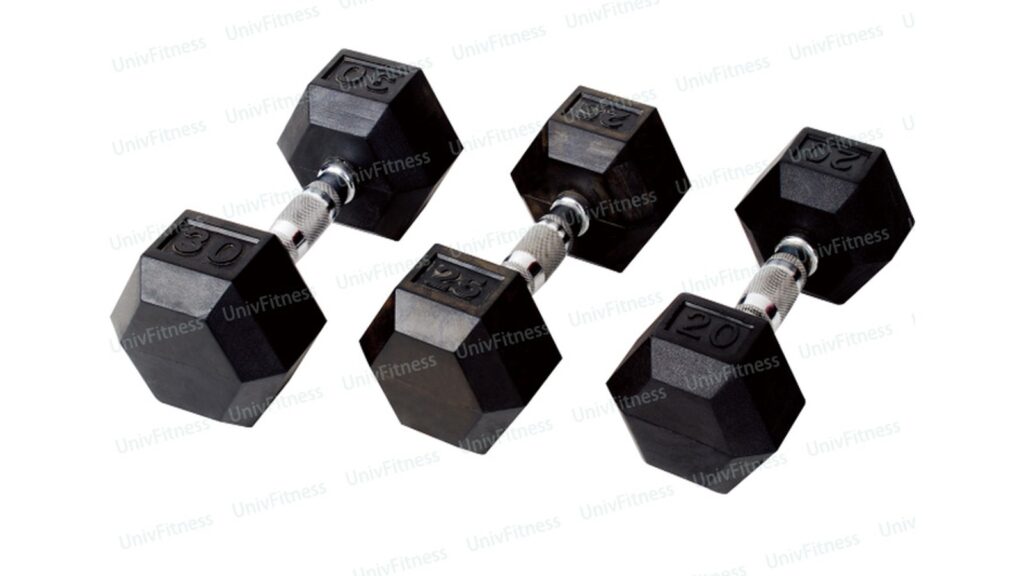
- Cast iron hex dumbbells (e.g. UV10601, 2.5–50 kg) — solid cast iron with a machined handle; the hex shape stops rolling.
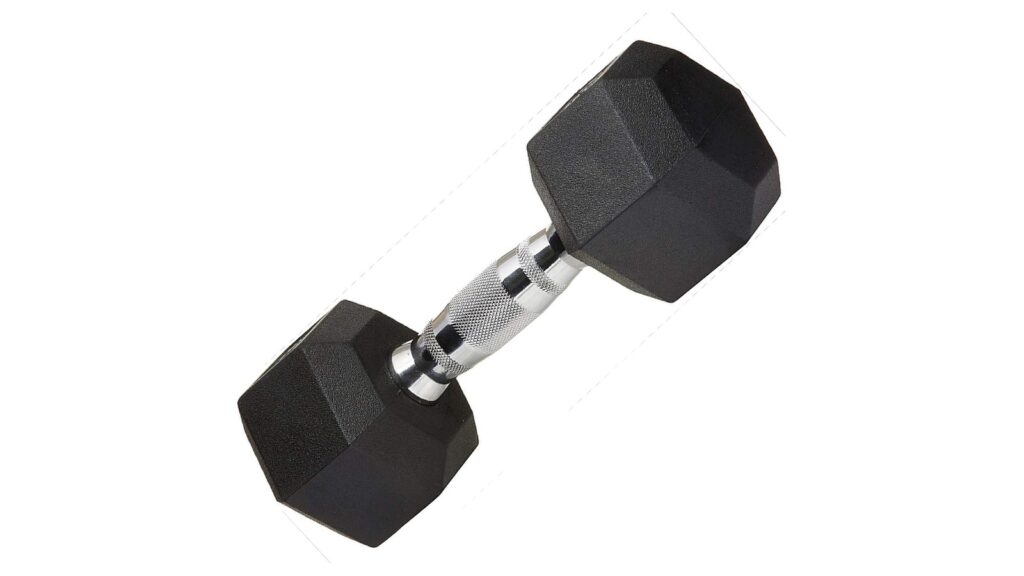
- Rubber hex dumbbells (e.g. UV10801, 2.5–50 kg) — available in rubber, TPU, or PEV coating over a chrome-plated steel handle. The coating protects floors and reduces noise; the chrome handle resists corrosion and sweat.
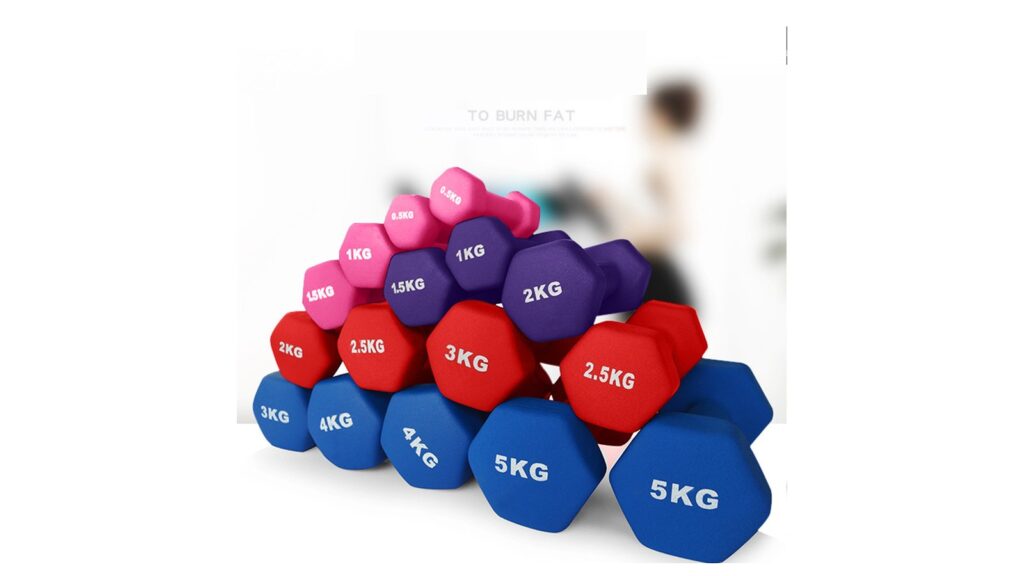
- Neoprene dumbbells (e.g. UV10201, 0.5–5 kg) — a vinyl/neoprene shell over cast iron, sized for aerobics and light home use.
- Vinyl-dipped cast iron kettlebells (e.g. UV12301/UV12302, 4–32 kg) — cast iron body with a protective vinyl coating and a smooth, burr-free handle.
Each construction answers a different use case — rubber hex for heavier commercial-grade free weights, neoprene for light home routines. Choosing the right grade for your customer is itself a safety decision.
2. Controlled weight tolerance
Free weights are sold by marked weight, and a plate that is meaningfully heavier or lighter than labelled creates both a liability and a customer-trust problem. Reputable factories hold dumbbells and plates to a tight weight tolerance (commonly around ±2–3%) and verify it by sampling during production. Ask your supplier for the stated tolerance and how they check it.
3. Edge and finish control
Blisters, sharp casting flash, exposed burrs, or a handle with rough chrome are the most common sources of cuts and complaints. Safety-conscious production deburrs castings, polishes handles, and finishes welds before coating.
4. Stable, labelled packaging and warnings
The safety duty extends into the carton. Products should ship with secure, non-migrating packaging, and — where your market requires it — warning labels, load ratings, and intended-use statements printed on the box or an insert. As the brand owner, the warning wording is ultimately your responsibility, so confirm what the factory can print for you.
The QC step that protects you
The single most important document you can own is proof that the exact units you imported were inspected — before, during, and after production.
UnivFitness runs a structured quality-control routine on every order:
- Inspection before production — raw materials and first articles are checked so that the specification is locked in before mass production starts.
- Inspection after production — finished goods are checked against the approved sample and specification.
- Inspection report per order — each order ships with a written inspection report, giving you a traceable record for your own files, your insurer, and any regulatory follow-up.
For OEM and private-label customers, this record is doubly valuable: it documents that your branded product, in your packaging, was checked to spec.
We also support free samples so you can verify construction, coating quality, and finish yourself before committing to a bulk order. Sample costs are credited back against the main order.
Documentation to request before you import
Use this checklist when qualifying any fitness equipment supplier:
- Specification sheet for each SKU (materials, dimensions, weight tolerance, coating).
- Test reports relevant to your market (e.g. EN ISO 20957, ASTM, REACH/RoHS chemical reports) — and confirm they were issued by a recognised lab and match the current standard version.
- Batch QC / inspection reports for your order.
- The factory’s own QC procedure, stated in writing.
- Product liability insurance — confirm the extent of coverage and who holds it.
- Warning labels and manual artwork, if your market requires them.
Be wary of any supplier that offers a “CE certificate” or test report you cannot verify against the issuing body. A genuine report names the product, the standard version, and the issuing laboratory. (See our companion guide on telling a real CE mark from a “China Export” mark.)
A practical safety checklist for your own brand
- Match the product grade to the end user — commercial vs home, supervised vs unsupervised.
- Confirm the correct standard class (e.g. EN ISO 20957 Class S vs Class H) before ordering.
- Lock the material choice against REACH/RoHS/CPSIA obligations for your market.
- Get the weight tolerance in writing and have it sampled.
- Demand an inspection report for your order and keep it on file.
- Print load ratings, warnings, and intended use in your target market’s language.
- Carry product liability insurance appropriate to your sales volume.
Source safer from the start
Product liability is not avoided by a single certificate — it is engineered into the material selection, the construction, and the inspection routine. UnivFitness manufactures dumbbells, yoga mats, resistance bands, kettlebells, and full-range fitness accessories for wholesale and OEM buyers, with free samples, inspection before and after production, and an inspection report for every order.
Our standard trade terms: MOQ from 1,000 pcs, FOB Shanghai, lead time around 30 days, payment 30% advance with 70% before shipment, and custom logo via moulded-in casting (for cast iron / painted items) or 1C single-color printing (for latex / soft-surface items). All prices are indicative FOB wholesale prices and vary with material, quantity, and specification.
To discuss specifications, request a sample, or get a quotation for your market, contact lyle@univfitness.com or use the Enquiry button on any product page.