Most import losses in this category are not dramatic fraud. Nobody disappears with your money. What happens instead is quieter and far more common: the supplier who quoted you is not the factory; the coating is one grade lower than specified; the weight tolerance is wider than you assumed; the carton quantity is short by a few percent; and by the time you discover any of it, the 70% balance has been paid and the container is on the water.
This guide is a working due-diligence checklist for wholesale buyers and distributors. It covers how to confirm you are dealing with the actual manufacturer, how to use samples and inspection as leverage, how payment structure protects you, and how to recognise a trader presenting as a factory. The benchmark terms throughout are the real published terms of UnivFitness, a Chinese fitness equipment manufacturer operating Wholesale & OEM Only, MOQ from 1,000 pcs, FOB Shanghai, 30-day lead time, 30% advance / 70% before shipment, free samples with the sample fee refunded on bulk order, and inspection before and after production with a report on every order.
The four categories of loss
Before the checklist, understand what you are actually protecting against:
| Risk | How it shows up | Cost |
|---|---|---|
| Wrong counterparty | Funds sent to an entity that is not the manufacturer; no recourse when the goods are wrong | Total |
| Specification substitution | Lower coating grade, lighter filler, different collar, thinner material | Margin and reputation |
| Quantity discrepancy | Fewer pieces per carton than the packing list states | Margin |
| Total non-performance | No goods, no refund | Total |
Each has a specific control. None of them require you to trust anyone.
Control 1: Verify the counterparty before you send a cent
Match three names. The entity on the business licence, the entity on the proforma invoice, and the entity receiving your bank transfer must be the same. A mismatch is the single most reliable fraud indicator in cross-border trade. If the supplier explains the mismatch as “our HK trading account handles exports”, ask for written confirmation of the relationship between the two entities — and understand that you are no longer dealing with the manufacturer as principal.
Ask for the export record. A manufacturer that ships containers has one. Ask which ports they ship from and how frequently. Under FOB Shanghai terms, the factory handles export clearance and loading — so they should be able to describe that process in detail.
Video-call the specific line. Not the showroom. Ask to see: the casting or coating line for dumbbells, the extrusion line for mats, the dipping line for bands, the welding and upholstery area for strength equipment. A trader will show you a sample room. A factory will show you a line, and will know what is running that day.
Test with technical questions. Only a maker answers from the line:
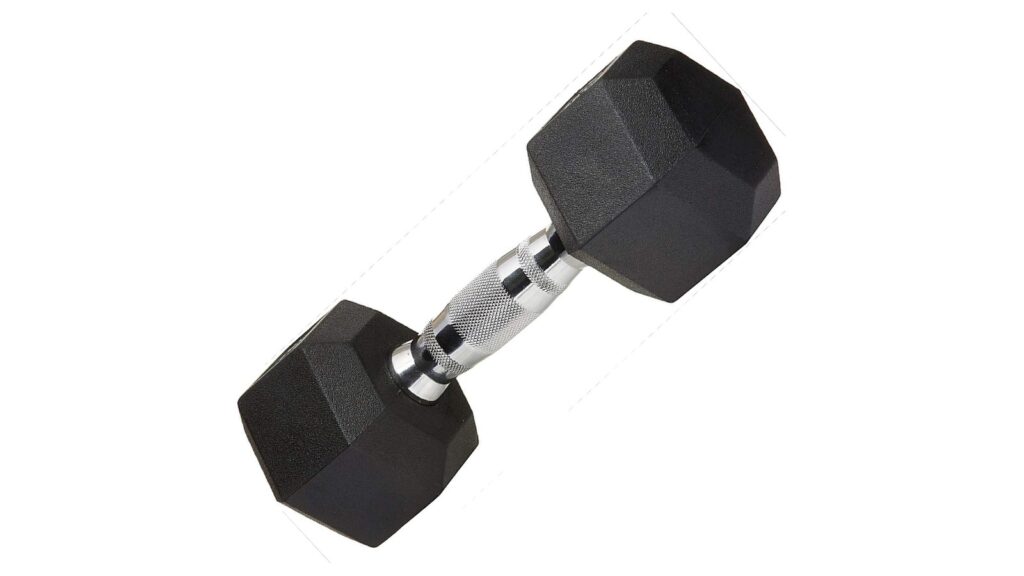
- What coating grades exist for the rubber hex dumbbell? → rubber / TPU / PEV
- What is the handle construction? → chromed steel
- What bar diameters are available on a 10 kg set? → 25 / 28 / 30 mm
- What is the bar length and collar type on UV11101? → 350 mm chromed bar, spring collars
- How many resistance levels does the latex power band have? → ten, at widths 0.64 / 1.3 / 1.9 / 2.2 / 2.9 / 3.2 / 4.4 / 4.5 / 6.4 / 8.3 cm
- What is the packing on UV11101? → 20 pcs per carton, carton 101 × 87 × 98 cm
A trader forwards these and answers tomorrow, or answers vaguely. That is your answer.
Check catalogue depth. Fraudulent or intermediary listings are thin. A real manufacturer’s catalogue shows depth where its tooling is: 772 strength and home gym products, 213 dumbbell and barbell products, 131 foam roller and yoga accessory products, 82 yoga mats, 77 jump ropes, 43 resistance band and tube products, 35 hand grips, 32 gym balls, 32 ankle and wrist weights, 31 ab rollers, 30 hula hoops, 21 push up bars — more than 1,500 SKUs across 13 categories.
Ask for references in your market. One reference who has taken a full container is worth more than any certificate. Then actually call them.
Control 2: Use the sample as a legal reference standard
Standard terms are free samples, with the sample fee refunded on the bulk order. That removes every cost excuse for not sampling. Use it properly:
Sample across the size range, not one size. For cast iron, a 2.5 kg casting and a 50 kg casting come from different tooling and can behave differently. Order samples at the low end, the middle and the top:
| Product | Real range | What to test on the sample |
|---|---|---|
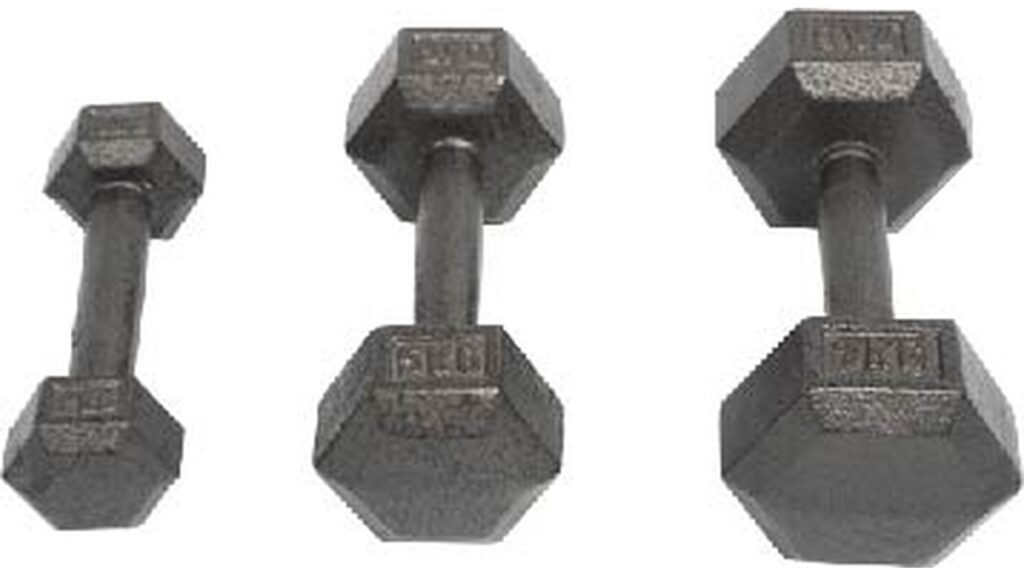
| UV10601 cast iron hex | 2.5–50 kg | Weigh each size on a calibrated scale; check paint coverage on flats and edges |
| UV10801 rubber hex | 2.5–50 kg | Handle-to-head joint under load; coating odour across rubber / TPU / PEV |
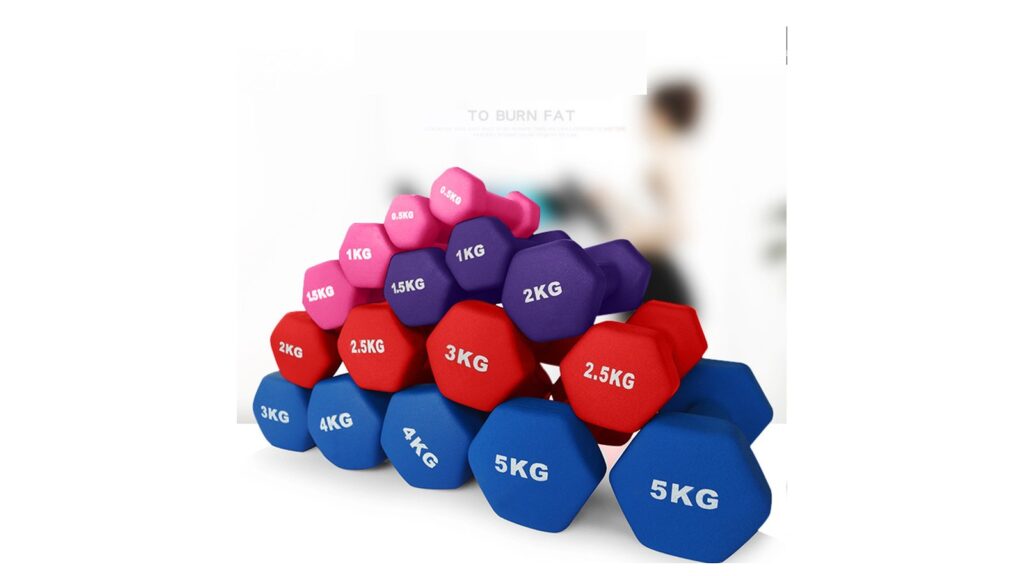
| UV10201 / UV10208 / UV10108 | 0.5–5 kg | Seam lifting after flexing; colour consistency across the full run |
| UV10302 PE sand-filled | 1–5 kg | Fill consistency and seam integrity |
| UV11101 10 kg set | 1.25 kg × 2 + 2.5 kg × 2 | Cycle the spring collars; confirm the plate breakdown matches the spec |
| UV11302 10 kg set | 1 kg × 4 + 2 kg × 2 | Confirm star collars seat correctly |
| UV43101 latex band | 10 resistance levels | Stretch to working length; check for bubbles, bloom, inconsistent thickness |
Sign and date an approval sample. Keep one sealed unit as the reference standard, and reference it in the purchase order: “Goods to conform to approval sample ref. X, dated Y.” If a dispute arises, this single step resolves most of it.
For heavy products, weight is the number that matters. Weigh every sample. Cement-filled sets (UV11402 at $4.53 indicative FOB wholesale price) and cast iron sets (UV11101 at $10.94) are priced for very different expectations — and weight tolerance is where substitution happens first.
Control 3: Make inspection a payment condition, not a courtesy
The standard commitment is inspection before and after production, with an inspection report issued for every order. Convert that into a contractual release condition.
Pre-production inspection covers:
- Raw material verification — is it the specified cast iron, the specified rubber / TPU / PEV grade, the specified TPE, NBR or PVC?
- Coating batch and colour match against your approval sample.
- Logo sample — for a mould logo on cast iron and painted products (UV11101), confirm crispness before the run; for 1C printing on latex and soft surfaces (UV43101, UV61501), confirm adhesion before the plate is set.
Post-production inspection covers:
- AQL sampling on finished goods against the approval sample.
- Weight checks, especially across a size range.
- Quantity per carton, carton marking, and packing list accuracy.
- Loading supervision, with container and seal numbers recorded.
Require photographs with the report: pallet view, open carton, product close-up, carton marking, and the loading sequence. It costs nothing and eliminates every version of “that is not what I approved”.
Write it into the purchase order: “The 70% balance is released upon buyer’s written acceptance of the pre-shipment inspection report.” A legitimate factory agrees immediately. Hesitation at this point is a finding.
Consider a third-party inspector for large orders. For a container of strength equipment — UV81494B 3D Smith machine at $1,076, UV81313 crossover cable jungle at $2,200, UV81321 five-station at $2,600 or UV81316 eight-station at $3,800, all indicative FOB wholesale prices — an independent inspector is cheap insurance. Ask the factory directly whether they will load against a third-party release. A real manufacturer will say yes.
Control 4: Payment structure is your leverage
Refuse 100% payment in advance, always. The standard structure is 30% advance payment, 70% before shipment, and the structure exists precisely because it protects both sides:
- The 30% deposit covers material buying and production scheduling. It is the factory’s protection against you walking away.
- The 70% balance is paid before shipment — after production, after inspection, and in practice against the inspection report. It is your protection against receiving goods that do not match.
A supplier who insists on 100% up front is asking you to give up the only leverage you have. There is no legitimate operational reason for it on a standard order.
Watch for payment-detail changes. If bank details change between the proforma invoice and the payment request — particularly if the change arrives by email shortly before payment is due — verify by voice call on a known number before transferring. Never act on emailed bank changes alone.
Ways to add protection on larger orders:
| Mechanism | How it works | When to use |
|---|---|---|
| 30% / 70% structure | Deposit to start, balance released against inspection report | Standard; use always |
| Letter of credit (L/C) | Your bank pays against presentation of compliant shipping documents — bill of lading, packing list, inspection certificate | Large orders, new supplier relationships; specify document requirements precisely |
| Platform escrow / trade assurance | Funds held by a third party until shipment and delivery conditions are met | Marketplace transactions |
| Third-party inspection release | Payment conditioned on an independent inspector’s pass | First container, or high-value machine orders |
Each has a cost — L/C has bank charges and strict document requirements, and a documentary discrepancy can delay payment. But on a container of free weights worth tens of thousands of dollars, the cost is trivial against the exposure.
Control 5: Recognise the trader presenting as a factory
Not fraud — but a real risk, because it removes your control over the schedule and the specification. Signals:
| Signal | What it means |
|---|---|
| “Any model, any quantity, MOQ 50 pcs” | Not factory economics — they are buying from stock |
| No model codes, or codes that change between emails | No ERP, no production system |
| Cannot explain the logo process | Has never run a branded order |
| Showroom video only, never the production floor | No floor to show |
| Technical answers arrive 24 hours later, forwarded | Someone else is answering |
| Carton dimensions unavailable or approximate | They do not control packing |
| Business licence name differs from invoicing and bank entity | You are not dealing with the principal |
| Cannot confirm coating grades, bar diameters or collar types | Reading a catalogue, not running a line |
A real factory does the opposite. It publishes MOQ by process — 1,000 pcs on dumbbells (UV10601, UV10801, UV10201, UV10208, UV10108, UV10302), bands (UV43101) and mats (UV21001, UV20901, UV20701); 500 pcs on neoprene kettlebells (UV13101, UV13102, UV13301, UV13302, UV13303, UV13201) and the UV61501 PVC ab mat; 1,004 pcs on the UV21108 cork + TPE mat. It explains that a mould logo applies to cast iron and painted surfaces and 1C printing to latex and soft surfaces. And it states its packing data without being asked: UV11101 at 20 pcs per carton, 101 × 87 × 98 cm; UV43101 at 5 pcs per colour card, 40 × 28 × 28 cm.
The pre-payment checklist
Run this before you transfer the deposit:
- [ ] Business licence name = proforma invoice name = bank account name
- [ ] Technical questions answered directly and within the same day
- [ ] Video confirmation of the specific production line
- [ ] Catalogue depth consistent with the claimed capability
- [ ] MOQ stated per model, and consistent with the process
- [ ] Logo process explained: mould for cast iron / painted, 1C printing for latex / soft
- [ ] Carton dimensions, pieces per carton and CBM provided in writing
- [ ] Samples ordered across the size range, or already received and weighed
- [ ] Approval sample signed, dated and retained
- [ ] Inspection report scope agreed, with photographs specified
- [ ] Payment terms confirmed as 30% advance / 70% before shipment
- [ ] Release condition written into the purchase order: balance released on acceptance of the inspection report
- [ ] Price basis confirmed as FOB Shanghai, with any CIF or DDP alternative quoted separately
- [ ] Lead time start condition written: 30 days from deposit and confirmed specification
- [ ] Bank details verified by voice on a known number
Run this again before you release the balance:
- [ ] Inspection report received and matches the agreed scope
- [ ] Photographs reviewed: pallet view, open carton, close-up, carton marking
- [ ] Quantity per carton confirmed against the packing list
- [ ] Weight checks passed on sampled units
- [ ] Container and seal numbers recorded
- [ ] Bank details unchanged from the original proforma invoice
What to do if something goes wrong
- Do not release the balance. This is why the 70% exists.
- Document in writing, with photographs. Reference your signed approval sample by its reference number.
- Ask for a corrective action plan in writing — rework, replacement or credit — with a date.
- Escalate to the named contact on the contract, not to whoever answers the chat.
- If you used an L/C or escrow, follow the discrepancy process rather than paying outside it.
- Record everything for the next sourcing round. A supplier who reworked without argument is worth keeping; one who argued is not.
Work with a supplier whose terms protect you by design
The best anti-fraud measure is a counterparty whose standard terms already align your interests with theirs: free samples so you can verify before committing, inspection before and after production so defects are caught while they are cheap to fix, a report on every order so you have evidence, and a 30 / 70 structure so your money stays partly in your hands until the goods are proven.
UnivFitness operates on exactly those terms — Wholesale & OEM Only, MOQ from 1,000 pcs, FOB Shanghai, 30-day lead time from deposit and confirmed specification, 30% advance payment and 70% before shipment, free samples with the sample fee refunded on the bulk order, inspection before and after production with an inspection report on every order, and custom colours, logo and private-label packaging across 13 categories and more than 1,500 SKUs.
Send your model list, quantities and verification document requests to lyle@univfitness.com, or use the Enquiry button on each product page. You will get carton data, specifications and terms in writing — before you are asked for any money.