Every importer has the same story. You found a supplier with a beautiful website, a fast reply, a lower price than anyone else — and then the container arrived with the wrong coating, the wrong weight tolerance, or the wrong quantity per carton. The supplier was not a factory. They were a trading company with a camera and a Gmail address, and the factory that actually made your goods was chosen by whoever gave them the best spot price that week.
Finding a real manufacturer is a solvable problem. Real factories leave evidence: in their catalogue depth, in their technical answers, in their MOQ logic, in their logo processes, and in the documents they can produce on request. This guide gives you the ten signals that distinguish a manufacturer from a trader, the audit checklist to run before you commit, and the exact documents to demand. All examples are drawn from the live catalogue and stated commercial terms of UnivFitness, a Chinese fitness equipment manufacturer operating Wholesale & OEM Only with MOQ from 1,000 pcs, FOB Shanghai pricing, 30-day lead time, 30% advance / 70% before shipment, free samples with the sample fee refunded on bulk order, and inspection before and after production with a report on every order.
Why “manufacturer vs trader” is the wrong first question
The right first question is: who controls the production schedule?
A trader can be competent. The problem is that a trader does not control the line — so when your order competes with a bigger customer’s order, yours moves. A manufacturer controls tooling, material buying, coating schedules and packing. When a manufacturer promises 30 days, they are committing their own line, not someone else’s.
Also, a trader cannot do real OEM. They can stick a label on a box. They cannot change a mould, adjust a rubber compound, or re-engineer a bar diameter. If your plan involves private label beyond a sticker, you need the factory.
The 10 signals of a real factory
1. Category depth, not category breadth
Traders list a little of everything. Manufacturers go deep where their tooling is. A genuine fitness equipment factory shows the following distribution across its 13 categories:
| Category | Products | Signal |
|---|---|---|
| Strength & Home Gym | 772 | Welding, fabrication and upholstery capability |
| Dumbbells & Barbells | 213 | Casting and coating capability |
| Foam Rollers & Yoga Accessories | 131 | Foam moulding capability |
| Yoga Mats | 82 | Extrusion and lamination capability |
| Jump Ropes | 77 | Injection and cable assembly |
| Resistance Bands & Tubes | 43 | Latex dipping |
| Hand Grips | 35 | Small injection and spring assembly |
| Gym Balls | 32 | Blow / rotational moulding |
| Ankle & Wrist Weights | 32 | Cut-and-sew |
| Ab Rollers | 31 | Injection + axle assembly |
| Hula Hoops | 30 | Tube extrusion |
| Push Up Bars | 21 | Tube or injection |
| Total | 1,549 SKUs | Tooling ownership at scale |
If a supplier claims to make cast iron dumbbells and shows six of them, they are reselling. If they show 213 dumbbell and barbell products across cast iron hex, rubber hex, neoprene, vinyl, PE and full barbell sets, they own the line.
2. They answer technical questions from the line, not from the catalogue
Ask these and listen carefully:
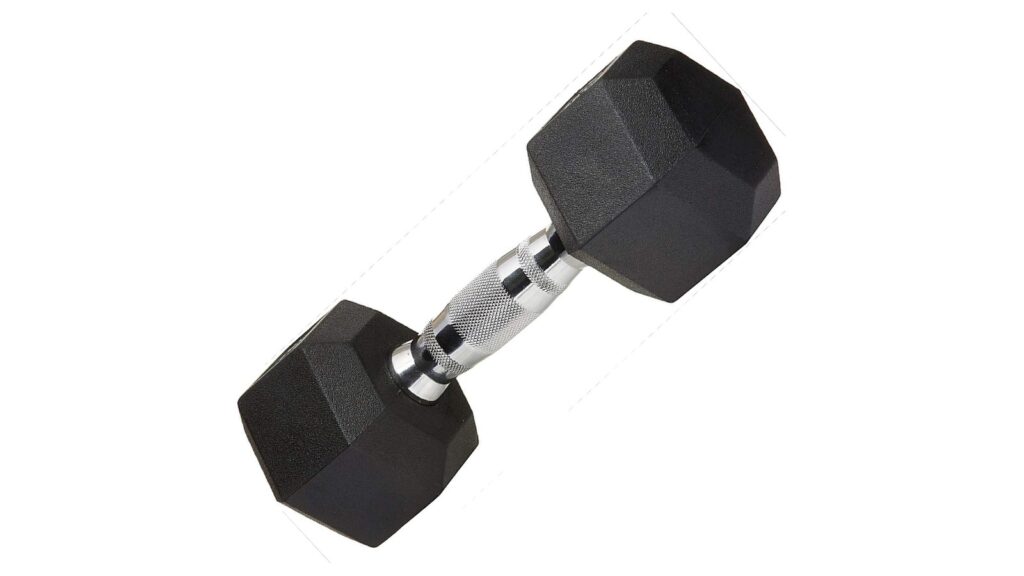
- “What coating options exist for your rubber hex dumbbell?” A factory says rubber / TPU / PEV, three distinct grades.
- “What is the handle construction?” A factory says chromed steel.
- “What bar diameters can you supply on a 10 kg set?” A factory says 25 / 28 / 30 mm.
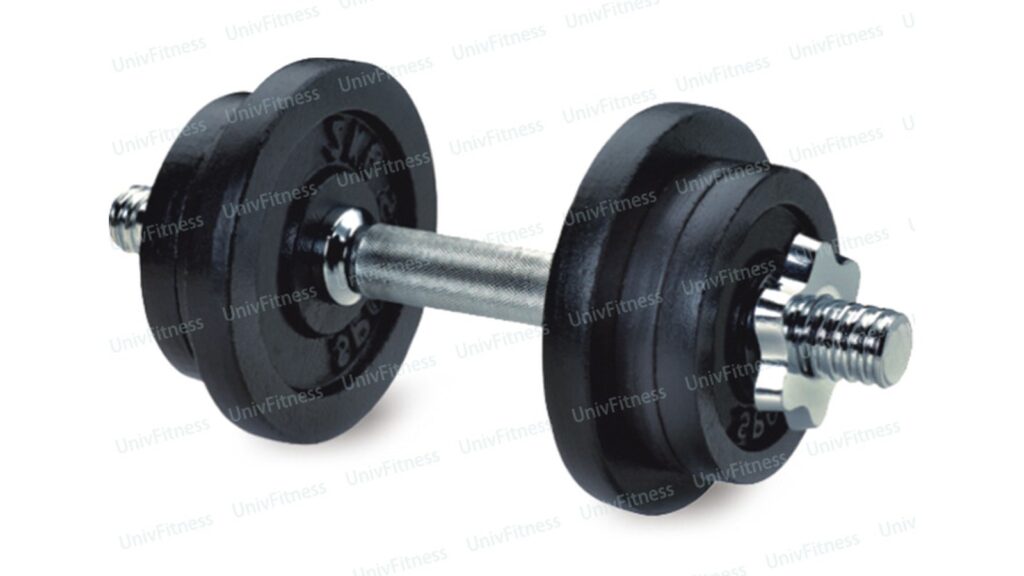
- “What is the bar length and collar type?” A factory says 350 mm chromed bar with spring collars (UV11101) or star collars (UV11302).
- “How many resistance levels does your latex power band have?” A factory says ten, and can list the widths: 0.64 / 1.3 / 1.9 / 2.2 / 2.9 / 3.2 / 4.4 / 4.5 / 6.4 / 8.3 cm.
A trader has to forward your email and come back tomorrow. Ask with a deadline and watch what happens.
3. Model codes that behave like a system
Real factories use structured SKUs, because their ERP needs them. Look for codes that map to material families:
- UV10601 cast iron hex, 2.5–50 kg
- UV10801 rubber hex with chromed steel handle, 2.5–50 kg
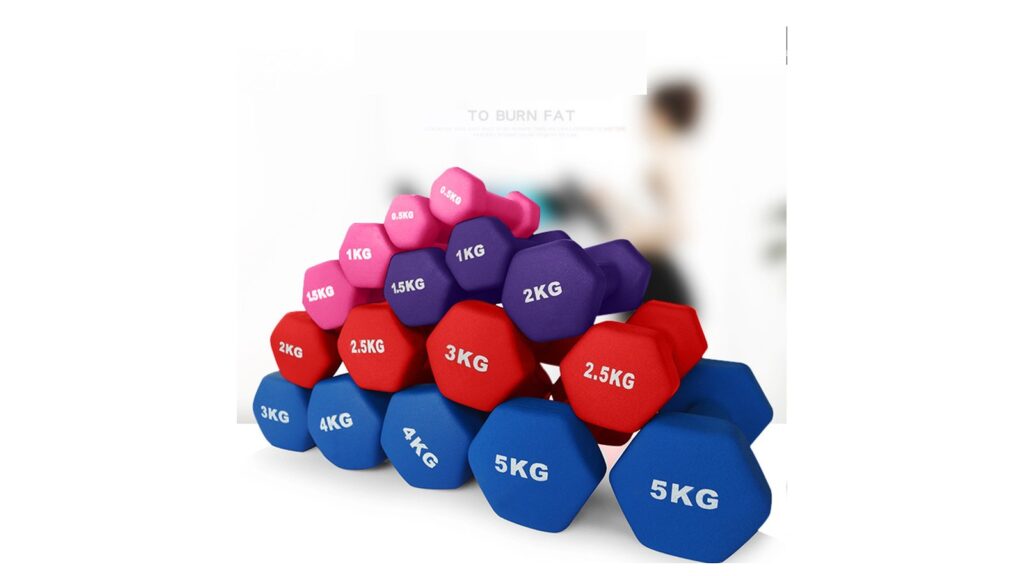
- UV10201 vinyl round head, 0.5 / 1 / 2 / 3 / 4 / 5 kg
- UV10208 neoprene hex, 1–5 kg
- UV10108 vinyl hex, 1–5 kg
- UV10302 PE hex with sand fill, 1–5 kg
Six models, six material and construction routes, one consistent weight architecture. That is a production system. Random codes pulled from Alibaba listings are not.
4. MOQ that reflects set-up cost, not negotiation
A factory’s MOQ is engineering, not sales policy. Different processes have different set-up economics, and a real factory’s minimums vary accordingly:
| Product | Material / construction | MOQ |
|---|---|---|
| UV10601 cast iron hex | Cast iron, painted | 1,000 pcs |
| UV10801 rubber hex | Rubber over cast iron, chromed handle | 1,000 pcs |
| UV10201 / UV10208 / UV10108 / UV10302 | Vinyl, neoprene, PE over cast iron or sand | 1,000 pcs |
| UV13101 / UV13102 / UV13301 / UV13302 / UV13303 | Neoprene kettlebells | 500 pcs |
| UV12301 / UV12302 vinyl-dipped kettlebells | Cast iron + vinyl | 1,000 pcs |
| UV61501 PVC ab mat | PVC + sponge | 500 pcs |
| UV21108 cork + TPE yoga mat | Cork laminated to TPE | 1,004 pcs |
A supplier who says “MOQ 100 pcs for anything, any model” is not quoting you factory economics — they are quoting from stock or from someone else’s production.
5. They can tell you how your logo will physically be applied
This is one of the fastest and most reliable tests. A manufacturer will tell you there are two processes, and which one applies to your product:
| Logo process | Where it is used | Example models |
|---|---|---|
| Mould — formed into the tooling or the cast surface | Cast iron and painted finishes | UV11101 |
| 1C printing — single-colour print onto soft surfaces | Latex and soft-face products | UV43101, UV61501 |
If a supplier cannot explain how the logo goes on, they have never run it. Ask what happens if you change artwork after tooling has started — a factory will tell you the mould route is locked once cut, while 1C printing can still be adjusted before the plate is set.
6. They publish carton data without being asked
Freight is half your landed cost, and only a manufacturer knows the real carton. Real packing data looks like this:
- UV11101 10 kg painted dumbbell set: 20 pcs per carton, carton 101 × 87 × 98 cm, set weight approx. 11 kg, indicative FOB wholesale price $10.94
- UV43101 latex power band: 5 pcs per colour card, carton 40 × 28 × 28 cm, listed unit weight 0.06 kg, indicative FOB wholesale price $1.13
A trader asks the factory for carton data and often gets it wrong. Ask for the packing list format they will use on your actual order.
7. They state commercial terms in one email, without hedging
A manufacturer’s standard position is fixed because it is operational:
| Term | Standard |
|---|---|
| Business model | Wholesale & OEM only; MOQ from 1,000 pcs |
| Price basis | FOB Shanghai |
| Lead time | 30 days |
| Payment | 30% advance payment, 70% before shipment |
| Samples | Free samples; sample fee refunded on bulk order |
| QC | Inspection before and after production; inspection report per order |
| OEM | Custom colours, logo, private-label packaging |
If a supplier needs three days to “check with the boss” whether they accept 30/70, they are not the principal.
8. QC is described as a process with output, not a promise
“Quality is our life” is not QC. Real QC has stages and a deliverable: inspection before production (raw material and colour/logo approval), inspection after production (finished goods against AQL), and an inspection report issued for every order. Ask what is in the report and whether photographs are included. Ask whether you can hold the 70% balance until you have seen it. A factory will say yes, because they intend to pass.
9. Their product range shows engineering trade-offs, not just options
Real catalogues expose trade-offs that only a maker would publish. Examples from a genuine line:
| Decision | Option A | Option B | The trade-off |
|---|---|---|---|
| 10 kg set construction | UV11101 painted cast iron — $10.94 indicative FOB | UV11201 chrome set — $12.23 indicative FOB | Paint is cheapest; chrome is the premium finish |
| 10 kg set filler | UV11302 rubber cast iron — $11.91 | UV11402 cement — $4.53 | Cement is a price-point product; cast iron is a durability product |
| Collar type | UV11101 spring collars | UV11302 star collars | Star collars are faster for the end user; spring collars cost less |
| Mat surface | UV21009 suede TPE | UV20703 PVC (1,580–2,000 g) | Suede is a grip premium; PVC is a price play |
A trader’s catalogue hides trade-offs, because trade-offs invite questions they cannot answer.
10. They can explain their own weak spots
Ask: “Which of your products should I not buy from you?” A manufacturer with 1,549 SKUs will tell you honestly where their strength is and where a specialist beats them. That answer is worth more than any certificate.
The factory audit checklist
Run this before you place a production order. Remote first, in person once the volume justifies it.
Documents to demand
- Business licence — and check that the entity name matches the name on the proforma invoice and the bank account.
- Export record / customs registration.
- Product specification sheets for every model you intend to buy, including weight tolerance, material composition and carton data.
- Material or compliance certificates relevant to your market, requested per product family.
- Sample approval form — signed and dated by both sides, with the sample retained as the reference standard.
- Inspection report template, so you know what you will receive before you order.
- Reference contacts in your region who have taken at least one full container.
Production questions to ask on the audit
- Where is the casting or moulding done — in-house or subcontracted? If subcontracted, where, and how is it inspected?
- How many shifts, and what is the realistic monthly output for my category?
- What happens to my schedule if a larger customer books the same line?
- Where does coating happen, and how is adhesion tested?
- How are weights calibrated and how often?
- Is packing in-house? Who writes the packing list?
- Can I appoint a third-party inspector, and will you load against their release?
Commercial checks
- Does the bank account name match the business licence? Always verify before the deposit.
- Is the proforma invoice detailed — model code, material, weight, carton quantity, CBM, price basis, lead time, payment terms?
- Are samples free with the fee refunded on the bulk order? Get this in writing.
How to run the evaluation in two weeks
- Day 1–2: Send the same technical RFQ to five suppliers. Include three questions only a maker can answer (coating grades, bar diameters, logo process).
- Day 3–5: Score responses. Eliminate anyone who cannot answer without forwarding.
- Day 6–8: Request documents and carton data for three candidate models.
- Day 9–12: Order samples across the full size range, not just one size. Weigh them. Stretch them. Drop-test the packaging.
- Day 13–14: Place a trial order with the winner at the minimum viable quantity, with the inspection report as the release condition for the 70% balance.
Then scale. Do not place your largest order with an unproven supplier, no matter how good the price looks.
Red flags that should end the conversation
- 100% payment demanded up front, with no inspection condition.
- Refusal to provide carton dimensions or packing list format.
- Business licence name different from the invoicing and bank entity.
- “MOQ 50 pcs, any model, any colour.”
- No model codes, or codes that change between emails.
- Showroom video only, never the production floor.
- Pressure to pay to a personal account, or to a third-country entity.
Work with a factory that will put it in writing
A reliable manufacturer is not the one with the lowest quote. It is the one that can state its terms, explain its processes, publish its carton data, and release your shipment against an inspection report.
UnivFitness manufactures across 13 categories and more than 1,500 SKUs — 772 strength and home gym products, 213 dumbbell and barbell products, 82 yoga mats, 43 resistance bands and tubes — on Wholesale & OEM terms with MOQ from 1,000 pcs, FOB Shanghai pricing, 30-day lead time, 30% advance and 70% before shipment, free samples with the fee refunded on bulk order, inspection before and after production with a report on every order, and custom colours, logo and private-label packaging.
Send your RFQ, technical questions and audit document list to lyle@univfitness.com, or use the Enquiry button on each product page. You will get answers from the production side, not from a catalogue.