Choosing a yoga mat material is not a design decision — it is a margin, logistics and channel decision in disguise. The polymer you pick determines your landed cost per unit, how many units fit in a container, which retail channel will accept the product, how fast it turns over on the shelf, and how many complaints you will field about smell, curling ends and peeling surfaces.
UnivFitness (www.univfitness.com) is a China-based fitness equipment factory supplying wholesale and OEM only, with 13 product categories including a yoga mats line of 82 models. This guide compares TPE, NBR and PVC using the actual specifications we produce, so you can map each material to a price tier, a channel and a customer profile before requesting a quote.
—
Why Material Choice Sits at the Centre of Your Yoga Mat Program
A yoga mat program usually fails at one of three points, and all three trace back to material: wrong weight class (too light for its thickness means curling corners; unnecessarily heavy means freight eats the margin), wrong channel fit (studio buyers want durability and cleanability; retail shoppers want first-touch feel and colour), and wrong price ladder (three tiers of the same material give customers no reason to trade up). The fix is to treat TPE, NBR and PVC as three distinct rungs, each with a defined weight range, thickness range and target channel.
—
The Three Material Families at a Glance
In short: TPE covers 173×61cm to 183×68cm across 0.3–1.0cm and is the mainstream mid-tier; NBR runs 180×60cm and 173×61cm from 0.6cm to 1.5cm and is the cushion-heavy value tier; PVC is 173×61cm from 0.14cm to 1.0cm and is the print-and-texture tier. Each is detailed below, then compared item by item.
TPE — the mainstream mid-tier
TPE (thermoplastic elastomer) is the material most private-label programs are built on today. It is closed-cell, so it does not absorb sweat, it can be produced in single colour, dual colour and camo, and it holds an embossed texture well.
- UV21001 (single colour, 173×61cm) — the widest thickness ladder in the TPE family: 0.3 / 0.4 / 0.5 / 0.6 / 0.7 / 0.8 / 0.9 / 1.0cm, MOQ 1,000 pcs. One artwork, eight price points.
- UV21002 (two-colour, 173×61×1.0cm) — seven weight grades: 700 / 860 / 1000 / 1120 / 1280 / 1420 / 1520g. Premium look without premium freight.
- UV21003 (camo, 173×61cm) — seven thickness steps from 0.4 to 1.0cm; for outdoor and functional-training assortments.
- UV21007 (alignment lines, 183×61×0.6cm, 800g) — printed posture lines turn a generic mat into a beginner-facing SKU.
- UV21008 (bound/edge-wrapped, 183×61×0.6cm, 800 / 1000g) — edge binding reduces corner curl, the most common yoga mat complaint.
- UV21009 (suede top, 183×68×0.6cm, 800g) — longer and wider than standard; grip improves with moisture, targeting hot yoga and Pilates.
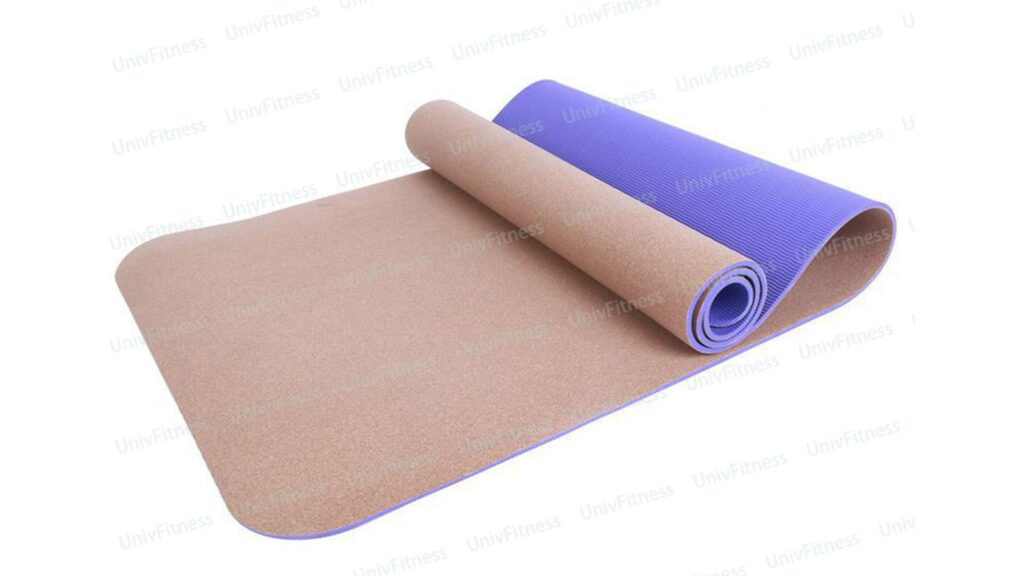
- UV21108 (cork + TPE, 183×61×1cm) — eight weight grades 400 / 550 / 700 / 850 / 970 / 1130 / 1270 / 1370g, indicative FOB wholesale price $11.48, MOQ 1,004 pcs; supports 1C printing logo application.
NBR — the cushion-heavy value tier
NBR (nitrile butadiene rubber) foam is the thickest-feeling material at the lowest weight per cubic centimetre, which is why it dominates the home-use and gym-floor segment. It is also the natural home for hanging-hole and edge-sewn constructions.
- UV20901 (180×60×1.0cm) — four weight grades 800 / 900 / 1050 / 1200g, MOQ 1,000 pcs. The classic volume driver.
- UV20903 (deluxe, 180×60cm) — four thickness steps 0.8 / 1.0 / 1.2 / 1.5cm. The 1.5cm option is where NBR stops competing with TPE and starts competing with floor matting.
- UV20904 (173×61×0.6cm, 1300g) — note the weight: 1,300g at only 0.6cm. This is a dense, firm NBR for buyers who want the material’s cushioning feel in a thinner, easier-to-ship profile.
- UV20906 (edge-sewn, 180×60×1cm, 1000 / 1300g) — stitched edge for studio and institutional buyers who launder or wipe down mats daily.
PVC — the print and texture playground
PVC is the heaviest of the three at equal thickness, and that weight buys two things buyers care about: a mat that lies flat immediately, and a surface that takes printing, hot-stamping and lamination better than any other substrate.
- UV20701 (honeycomb, 173×61×1cm) — six weight grades 800 / 900 / 1050 / 1250 / 1400 / 1550 / 1700g.
- UV20703 (straight grain with printed pattern, 173×61×1.0cm) — five weight grades 1580 / 1680 / 1790 / 1900 / 2000g. At 2,000g this is the densest mat in the comparison — a deliberate “heavy = quality” positioning for retail shoppers who judge a mat by lifting it.
- UV20708 (hot-stamped PVC + PU, 173×61cm) — 0.4 / 0.5 / 0.6cm; metallic hot-stamp finish for gift and fashion-led assortments.
- UV20711 (deluxe suede PVC + suede, 173×61cm) — 0.14 / 0.33cm; the ultra-thin travel and studio-overmat tier.
- UV20712 (foldable, 173×61×0.2cm) — folds flat for travel retail and commuter programs.
- UV20717 (three-line, 173×61×0.6cm) — printed alignment variant at mid thickness.
—
Spec Sheet Comparison: Real Models, Real Numbers
| Model | Material | Size | Thickness options | Weight options | MOQ |
|---|---|---|---|---|---|
| UV21001 | TPE single colour | 173×61cm | 0.3/0.4/0.5/0.6/0.7/0.8/0.9/1.0cm | by thickness | 1,000 |
| UV21002 | TPE two-colour | 173×61cm | 1.0cm | 700/860/1000/1120/1280/1420/1520g | 1,000 |
| UV21003 | TPE camo | 173×61cm | 0.4–1.0cm (7 steps) | by thickness | 1,000 |
| UV21007 | TPE alignment lines | 183×61cm | 0.6cm | 800g | 1,000 |
| UV21008 | TPE bound edge | 183×61cm | 0.6cm | 800/1000g | 1,000 |
| UV21009 | TPE suede | 183×68cm | 0.6cm | 800g | 1,000 |
| UV21108 | Cork + TPE | 183×61cm | 1.0cm | 400/550/700/850/970/1130/1270/1370g | 1,004 |
| UV20901 | NBR | 180×60cm | 1.0cm | 800/900/1050/1200g | 1,000 |
| UV20903 | NBR deluxe | 180×60cm | 0.8/1.0/1.2/1.5cm | by thickness | 1,000 |
| UV20904 | NBR | 173×61cm | 0.6cm | 1300g | 1,000 |
| UV20906 | NBR edge-sewn | 180×60cm | 1.0cm | 1000/1300g | 1,000 |
| UV20701 | PVC honeycomb | 173×61cm | 1.0cm | 800/900/1050/1250/1400/1550/1700g | 1,000 |
| UV20703 | PVC printed | 173×61cm | 1.0cm | 1580/1680/1790/1900/2000g | 1,000 |
| UV20708 | PVC + PU hot-stamp | 173×61cm | 0.4/0.5/0.6cm | by thickness | 1,000 |
| UV20711 | PVC + suede deluxe | 173×61cm | 0.14/0.33cm | by thickness | 1,000 |
| UV20712 | PVC foldable | 173×61cm | 0.2cm | by thickness | 1,000 |
| UV20717 | PVC three-line | 173×61cm | 0.6cm | by thickness | 1,000 |
—
Density: The Number That Explains Almost Everything
Weight alone is meaningless without thickness. Divide the published weight by the mat’s volume (length × width × thickness) and you get an effective bulk density — the fastest way to compare two mats that are both “1cm thick”.
| Model | Material | Volume (m³, calc.) | Weight | Effective bulk density (kg/m³, calc.) |
|---|---|---|---|---|
| UV21002 | TPE two-colour | 0.01055 | 1520g / 700g | ~144 / ~66 |
| UV21108 | Cork + TPE | 0.01116 | 1370g / 400g | ~123 / ~36 |
| UV20901 | NBR | 0.01080 | 1200g | ~111 |
| UV20904 | NBR | 0.00633 | 1300g | ~205 |
| UV20701 | PVC honeycomb | 0.01055 | 1700g | ~161 |
| UV20703 | PVC printed | 0.01055 | 2000g | ~190 |
Density figures above are calculated from the published dimensions and weight options for comparison purposes only; they are not a factory specification.
What the table tells a buyer:
- TPE offers the widest density spread (~66 to ~144 kg/m³ at 1.0cm), so one mould can serve a budget SKU and a premium SKU — you buy a weight grade, not a new tool.
- PVC sits at the top (~161 to ~190 kg/m³): at the same 1.0cm the heaviest PVC mat carries roughly 30% more material than the heaviest two-colour TPE mat. That extra mass buys shelf-perceived substance and costs freight.
- NBR UV20904 is the outlier at ~205 kg/m³ and only 0.6cm — dense-but-thin suits balance work and standing sequences without shipping a thick roll.
Run the freight arithmetic before you quote: 1,000 pieces of UV21002 TPE at 1,520g is 1,520 kg of product weight, against 2,000 kg for UV20703 PVC at 2,000g — a 480 kg difference per 1,000 pieces, before packaging. On sea freight that is absorbable; on air or parcel-based cross-border it is the entire margin. The rule: if your channel bills on actual weight, TPE wins; if your customer pays for perceived substance at shelf, PVC wins.
—
Rebound, Grip, Odour, Weather Resistance: Item-by-Item
| Property | TPE | NBR | PVC |
|---|---|---|---|
| Rebound / recovery | Fast, closed-cell spring-back; recovers well after compression | Slower, deeper compression; feels softer under knees and spine | Very low compression; lies flat, minimal spring-back |
| Dry grip | Good with embossed or suede top (UV21009) | Good, foam-friction based | Good, texture-dependent (honeycomb UV20701, straight grain UV20703) |
| Wet grip | Improves on suede (UV21009) and cork (UV21108) surfaces | Can become slippery when saturated | Generally the strongest wet-grip substrate; popular for hot yoga |
| Odour out of the bag | Lowest of the three | Low-to-moderate | Highest; requires airing-out time before retail |
| Print / decoration capability | Two-colour (UV21002), camo (UV21003), printed alignment lines (UV21007) | Limited; relies on colour and edge finish (UV20906) | Best-in-class: hot-stamp (UV20708), printed patterns (UV20703), digital prints, lamination (UV20711) |
| Laying flat | Good; bound-edge versions (UV21008) best | Good at 1.0cm+ | Excellent — weight does the work |
| Cold-weather handling | Stays flexible | Stays flexible | Stiffens in cold; avoid winter outdoor demos |
| Recyclability / perception | Strongest environmental story | Neutral | Weakest environmental perception; must be positioned on performance, not sustainability |
| Relative cost position | Mid | Value | Value-to-mid, varies with print complexity |
—
Price Positioning: What the Published Numbers Tell You
UnivFitness publishes an indicative FOB wholesale price on selected SKUs; use them as anchors for your tiers.
| Anchor SKU | Material | Indicative FOB wholesale price | Role in your range |
|---|---|---|---|
| UV20801 | EVA, dot texture | $1.48 | Entry / promotional floor |
| UV21108 | Cork + TPE, 8 weight grades | $11.48 | Premium TPE-family anchor |
| UV21105 | Cork | $18.75 | Top-of-range natural mat |
TPE, NBR and PVC models in the UV210/UV209/UV207 series are quoted per specification, because price moves with thickness, weight grade and print method. Always request a quote against model + thickness + weight grade + print method + packaging.
—
Material Selection Decision Table
| If your priority is… | Choose | Recommended model | Why |
|---|---|---|---|
| Lowest landed cost on a thick mat | NBR | UV20903 at 1.2 or 1.5cm | Maximum cushion per kilogram shipped |
| Best freight economics for e-commerce | TPE | UV21002, 700–1000g grade | Lightest premium-looking option at 1.0cm |
| One SKU covering eight price points | TPE | UV21001, 0.3–1.0cm | Single artwork, eight thickness steps, MOQ 1,000 |
| Beginner-facing retail with a story | TPE | UV21007 (alignment lines) or PVC UV20717 | Printed guidance justifies a higher retail price |
| Hot yoga / Pilates studio | TPE suede or cork | UV21009 or UV21108 | Grip improves with moisture; cork reads premium |
| Max shelf impact and print freedom | PVC | UV20703 (printed, up to 2,000g) | Heaviest, flattest, best print substrate |
| Travel, commuter, overmat | PVC | UV20711 (0.14/0.33cm) or UV20712 (foldable, 0.2cm) | Packs flat, minimal volume |
| Studio / institutional daily use | NBR | UV20906 (edge-sewn, 1000/1300g) | Stitched edge survives repeated handling |
| Premium / natural positioning | Cork + TPE | UV21108 ($11.48) | Eight weight grades, 1C printing logo |
| Kids and playroom | EVA | UV21501 ($1.92), UV21509 ($5.95) | Interlocking tiles, not rolled mats |
—
How to Build a Three-Tier Yoga Mat Assortment
- Tier 1 — Traffic driver. NBR UV20901 at 1.0cm, 800–900g grade, or EVA UV20801 at $1.48. Wins the search result and the shelf.
- Tier 2 — Volume margin. TPE UV21001 in two thickness steps (0.5cm and 0.8cm), or UV21002 two-colour at a mid weight grade — a visual upgrade over Tier 1 without a new mould.
- Tier 3 — Brand ceiling. Cork + TPE UV21108 (indicative FOB wholesale price $11.48) or suede UV21009; gives the range a ceiling so Tier 2 looks reasonable.
- One specialist SKU per channel: alignment-line UV21007 for beginners, foldable UV20712 for travel retail, edge-sewn UV20906 for studios.
—
OEM and Private-Label Options
UnivFitness supports OEM on the full mat range:
- Custom colours — including two-colour TPE (UV21002) and camo (UV21003).
- Logo application — soft-surface and latex-type products such as UV21108, UV43101 and UV61501 use 1C printing; cast iron and painted metal products such as UV11101 use a mould logo. Specify the process when sending artwork — the two need different files and different lead times.
- Private-label packaging — colour cards, hangtags, printed sleeves and carton marking.
—
Trade Terms (Standard Across the Site)
| Term | Detail |
|---|---|
| Business model | Wholesale & OEM only, MOQ from 1,000 pcs |
| Incoterm | FOB Shanghai |
| Lead time | 30 days |
| Payment | 30% advance + 70% before shipment |
| Samples | Free samples; sample cost is refunded against the bulk order |
| Quality control | Inspection before and after production, with an inspection report issued per order |
| Contact | lyle@univfitness.com |
Yoga mats sit inside a 13-category catalogue including Foam Rollers & Yoga Accessories (131), Yoga Mats (82), Resistance Bands & Tubes (43) and Gym Balls (32) — so a mat order can be consolidated with accessories into one FOB Shanghai shipment.
—
Frequently Asked Questions
Which material should a first-time private-label buyer start with?
TPE, specifically UV21001: eight thickness steps from 0.3 to 1.0cm at MOQ 1,000 let you test three price points with one artwork and one mould.
Is PVC still viable given environmental concerns?
Yes, where performance and print drive the purchase — hot yoga, travel, promo and gift. Position it on grip, flatness and design, not on sustainability.
Does a heavier mat mean a better mat?
Not inherently. At 1.0cm, UV21002 TPE tops out at 1,520g while UV20703 PVC reaches 2,000g. PVC lies flatter and feels more substantial; TPE ships cheaper.
What is the minimum order quantity?
MOQ from 1,000 pcs across the range; UV21108 is specified at 1,004 pcs.
—
Ready to Spec Your Mat Range?
Send us your target retail price, channel and material preference, and we will map it to specific models, thickness steps and weight grades — then quote against a defined specification rather than a generic description.
Send an inquiry to lyle@univfitness.com or use the Enquiry button on each product page.